
Last fact-checked: 8 September 2026
Medical review status: Review by Dr. Parash Shrestha
Hair transplant cost in Nepal in 2026 does not follow one official national price. Among clinics with publicly displayed rates reviewed in September 2026, advertised examples range from roughly NPR 35 to NPR 85 per graft. At those rates, 3,000 grafts would illustrate a market range of about NPR 105,000 to NPR 255,000. These figures are examples from other publicly advertised hair transplant clinic prices, not a quotation from Dr. Parash Shrestha.
Your actual cost depends on much more than multiplication. The number of suitable grafts, donor-area quality, area requiring coverage, surgical technique, procedure complexity, medical supervision, medicines, investigations and follow-up can all affect the final quotation.
For anyone considering a hair transplant in Nepal, the most useful question is therefore not simply, “What is the cheapest price per graft?” It is: How many grafts are medically appropriate for me, who is performing the important surgical steps, what does the quotation include, and what is the long-term plan for my remaining hair?
How Much Does a Hair Transplant Cost in Nepal in 2026?
There is no government-set or universally accepted hair-transplant price in Nepal. Individual clinics establish their own fees, and those fees may be expressed per graft, as a procedure package, or as a combination of both.
A review of selected publicly available Nepal clinic pricing in September 2026 found examples ranging from approximately NPR 35 per graft at one provider to NPR 85 per graft at another. Another provider publicly lists a range of NPR 65–80 per graft.
These prices are useful for understanding the market, but they should not be treated as an official Nepal average. They also do not establish the current fee charged by Dr. Parash Shrestha.
Dr. Shrestha’s existing hair-transplant information explains that final cost can depend on graft requirements, recipient area, donor characteristics, technique, procedure duration, anaesthesia, consumables, investigations, medicines and follow-up.
That distinction matters. Two clinics quoting the same number of grafts may provide very different levels of medical evaluation, surgical involvement and aftercare.
Hair Transplant Price Per Graft in Nepal: An Illustrative 2026 Calculator
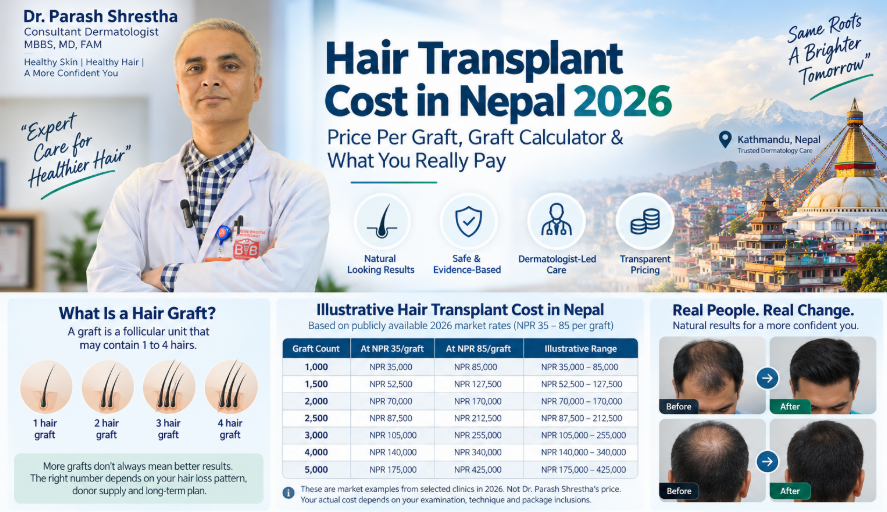
Using the NPR 35–85 publicly advertised market examples above, an illustrative calculation looks like this:
| Graft estimate | At NPR 35/graft | At NPR 85/graft | Illustrative market span* |
|---|---|---|---|
| 1,000 grafts | NPR 35,000 | NPR 85,000 | NPR 35,000–85,000 |
| 1,500 grafts | NPR 52,500 | NPR 127,500 | NPR 52,500–127,500 |
| 2,000 grafts | NPR 70,000 | NPR 170,000 | NPR 70,000–170,000 |
| 2,500 grafts | NPR 87,500 | NPR 212,500 | NPR 87,500–212,500 |
| 3,000 grafts | NPR 105,000 | NPR 255,000 | NPR 105,000–255,000 |
| 4,000 grafts | NPR 140,000 | NPR 340,000 | NPR 140,000–340,000 |
| 5,000 grafts | NPR 175,000 | NPR 425,000 | NPR 175,000–425,000 |
*These are mathematical examples based on selected clinics’ publicly displayed 2026 rates. They are not a national tariff, recommended fee or quotation from Dr. Parash Shrestha. Individual clinic fees and package inclusions can differ substantially.
The practical lesson is simple: graft count can substantially change the total price, but the cheapest rate is not automatically the lowest total cost or the best treatment plan.
Hair transplant cost formula
For a clinic that genuinely charges per graft, a simple calculator is:
Estimated surgical price = recommended graft count × verified price per graft
Then add any charges not included in the per-graft quotation, such as:
- consultation;
- preoperative tests;
- medicines;
- anaesthesia or consumables if billed separately;
- postoperative dressings or washes;
- scheduled follow-up;
- additional hair-loss treatment;
- travel or accommodation if coming from outside Kathmandu.
Before using an online graft calculator, remember that the calculator cannot assess your donor density, miniaturisation, scalp disease, hair calibre or future progression of hair loss. Those factors require clinical examination.
What Exactly Is One Hair Graft?
A hair graft is usually a follicular unit, not simply one strand of hair.
Naturally occurring follicular units may contain approximately one to four terminal hairs. This means 2,000 grafts does not necessarily mean exactly 2,000 hairs.
This distinction matters when patients compare quotations.
One person may have many multi-hair follicular units with favourable shaft calibre and donor density. Another may have finer hair, fewer multi-hair units or a weaker donor area. The visual coverage achievable from the same nominal number of grafts can therefore differ.
A good transplant plan considers not only the number of grafts but also:
- hair calibre;
- hair colour and scalp contrast;
- donor density;
- follicular-unit composition;
- hair direction and curl;
- recipient-area size;
- desired hairline;
- future progression of hair loss.
That is one reason price-per-graft comparisons alone can oversimplify a medical and aesthetic procedure.
How Many Hair Grafts Do I Need?
There is no reliable way to prescribe a graft number from a photograph or Norwood stage alone.
A clinician needs to assess the size of the thinning area, donor availability, hair characteristics, existing miniaturised hair and the patient’s long-term goals.
Modern hair-transplant guidance emphasises stable hair loss, a healthy scalp, adequate donor hair and realistic expectations when selecting candidates.
Smaller graft requirements
A relatively limited frontal or temporal recession may require fewer grafts than extensive frontal, mid-scalp and crown loss.
But “fewer grafts” does not mean the procedure is simple. Natural hairline design may require careful distribution of single-hair follicular units along the front, with larger follicular units placed farther behind to create visual density.
Larger graft requirements
More extensive baldness may require several thousand grafts. However, simply increasing the graft number is not always desirable.
The donor area is finite.
Once follicles are harvested, they cannot be replaced in their original location. Excessive extraction can create visible donor thinning, patchiness or a depleted appearance. Current medical literature lists donor depletion and overharvesting among recognised FUE complications.
The relevant question is therefore:
How many grafts can be safely moved while preserving enough donor reserve for the future?
That is more important than choosing the largest graft package advertised online.
Think of Your Donor Area as a Long-Term Hair Budget
This is one of the most useful ways to evaluate both graft numbers and cost.
The donor scalp contains a limited supply of transplantable follicles. At the same time, androgenetic hair loss may continue for years in non-transplanted areas.
If too much donor hair is used to create an aggressive low hairline at a young age, fewer grafts may remain available later if the mid-scalp or crown continues to thin.
A technically possible transplant today may therefore be a poor long-term plan.
A conservative approach considers:
- your present pattern of hair loss;
- your probable future hair-loss pattern;
- your donor supply;
- the visual priority of different scalp areas;
- whether medical treatment may help preserve native hair;
- whether a second procedure might eventually be required.
StatPearls specifically notes that younger patients with rapidly progressing male-pattern hair loss require caution because early transplantation can consume donor supply and compromise long-term results.
This long-term planning is one reason the cheapest initial quotation may not represent the best lifetime value.
What Factors Affect Hair Transplant Cost in Nepal?
1. Number of grafts
This is often the most obvious pricing factor.
A patient needing approximately 1,500 grafts will generally require less harvesting, preparation and placement time than someone requiring 3,500 or 4,000 grafts.
However, graft requirement should be based on examination rather than on how much the patient can afford or how large a package is being promoted.
2. Size and location of the recipient area
A receding frontal hairline, frontal-third thinning, mid-scalp thinning and crown baldness present different planning challenges.
The crown is particularly important because its spiral growth pattern and potentially large area can consume a considerable donor supply.
3. Donor-area quality
Good donor density, favourable hair calibre and suitable follicular units may provide stronger visual coverage.
Weak donor density, significant miniaturisation, previous surgery or scarring may make harvesting more complex or limit how many grafts can safely be obtained.
4. Technique used
FUE and FUT describe two established approaches to obtaining donor follicular units.
With FUE, follicular units are individually excised. With FUT, a strip of donor scalp is removed and subsequently dissected into follicular units. Both remain recognised hair-transplant approaches.
Some clinics also market terms such as DHI or DHT. These may describe implantation methods, devices or clinic-specific workflows rather than a fundamentally different biological concept.
Do not assume the procedure with the newest acronym is automatically better.
Ask what actually changes in:
- donor harvesting;
- recipient-site creation;
- implantation;
- graft handling;
- doctor involvement;
- expected scarring;
- procedure duration;
- suitability for your donor area.
5. Complexity of hairline design
Hairline design is not simply drawing a straight line across the forehead.
Age, facial proportions, future hair loss, temporal recession and the availability of single-hair grafts all matter.
An unnaturally low or dense hairline can become difficult to maintain as the surrounding native hair continues to thin.
6. Previous hair transplant surgery
Revision cases can be more complex.
Previous extraction, scarring, depleted donor zones or unnatural graft placement can limit the options available for corrective surgery.
7. Medical evaluation
A hair transplant should not be the automatic answer to every form of hair fall.
Temporary telogen effluvium, alopecia areata, active inflammatory scalp disease, nutritional problems and diffuse forms of hair loss require different management.
If you have recent or unexplained thinning, review the causes of hair thinning and the wider causes of hair fall in men and women before assuming surgery is the solution.
8. Anaesthesia, consumables and facility costs
Hair transplantation is generally performed with local anaesthesia, but the exact protocol and clinic setup vary.
Sterile equipment, surgical consumables, trained personnel and emergency preparedness all contribute to procedure costs.
9. Medicines, investigations and follow-up
A low advertised procedure price may not represent the final amount paid.
Ask whether the quotation includes:
- consultation;
- preoperative blood tests if required;
- prescribed medicines;
- dressings;
- washing or postoperative scalp care;
- scheduled follow-up;
- management of complications;
- additional hair-loss therapy.
Is the Cheapest Hair Transplant in Nepal the Best Value?
Not necessarily.
Price matters, but hair transplantation is surgery. The consequences of poor planning can involve donor depletion, scarring, infection, graft failure, an unnatural hairline or the need for difficult corrective work.
The International Society of Hair Restoration Surgery warns patients to understand who will perform important medical and surgical portions of their transplant rather than being guided mainly by advertising or low prices. Its consumer guidance specifically highlights the importance of appropriate physician involvement in diagnosis, surgical planning, donor harvesting, hairline design and recipient-site creation.
Before comparing two quotations, compare what the quotations actually represent.
A useful comparison is:
| Question | Why it matters |
|---|---|
| Who diagnoses the hair-loss condition? | Not all hair loss requires surgery |
| Who designs the hairline? | Determines long-term aesthetics |
| Who harvests donor follicles? | Influences graft quality and donor preservation |
| Who creates recipient sites? | Influences direction, angle and distribution |
| How was the graft estimate calculated? | Helps identify inappropriate over-treatment |
| What technique is actually being used? | Marketing names can be confusing |
| What is included in the quoted price? | Prevents unexpected additional costs |
| What follow-up is included? | Complications and healing need appropriate review |
| What happens if native hair keeps thinning? | Transplantation does not stop future androgenetic hair loss |
| How is donor reserve protected? | Donor follicles are finite |
The purpose is not to choose the most expensive clinic either.
It is to understand the relationship between medical planning, surgical responsibility, realistic graft requirements and total cost.
If you are comparing graft packages but do not yet know the cause or stability of your hair loss, the next useful step is a clinical assessment, not choosing a package online.
A dermatologist-led hair transplant assessment in Nepal can help establish whether transplantation is appropriate, how the donor area should be evaluated and what level of coverage is realistic.
FUE vs FUT vs DHI: Does Technique Change the Price?
It can.
FUE and FUT are established donor-harvesting approaches, while terminology such as DHI commonly refers to aspects of implantation or specific clinic workflows.
Different approaches can influence:
- operating time;
- number of staff involved;
- equipment requirements;
- harvesting process;
- scarring pattern;
- procedure complexity;
- graft-handling workflow.
That can affect the quotation.
But the method should not be selected purely because one is cheaper or marketed as “advanced.”
Current reviews describe both follicular unit excision and linear strip excision/FUT as established contemporary approaches.
The better question is:
Why is this method being recommended for my donor characteristics, hairstyle, graft requirement and long-term plan?
What Should Be Included in a Hair Transplant Quotation?
Before paying a deposit, ask for a written explanation of the quotation.
Ideally, you should be able to identify:
Clinical assessment
Does the quote include a medical assessment of your hair-loss pattern and scalp?
Estimated graft requirement
Is the graft number an approximate target or guaranteed count?
How will the clinic handle the situation if fewer safe grafts can be harvested than initially estimated?
Surgical technique
Does the quote clearly explain the harvesting and implantation method?
Physician involvement
Who performs each important stage?
Do not rely only on a celebrity doctor appearing in an advertisement. Ask what that doctor personally does during your procedure.
Medicines and tests
Are preoperative investigations, postoperative medications and dressings included?
Follow-up
How many follow-up visits are included?
What happens if there is unexpected swelling, infection, folliculitis, poor healing or another complication?
Taxes and additional charges
Ask whether the stated amount is the complete payable amount.
Optional add-ons
PRP, growth-factor treatments, special shampoos or other procedural add-ons should be listed separately rather than presented as mandatory without explanation.
Who Is a Good Candidate for a Hair Transplant?
Hair transplantation is generally best considered in appropriately selected patients with permanent or stable hair loss, adequate donor hair, a healthy scalp and realistic expectations.
Clinical guidance emphasises diagnosis before surgery because several forms of hair loss may be unsuitable for transplantation or require stabilisation first.
You may require additional evaluation if you have:
- sudden heavy shedding;
- patchy hair loss;
- scalp pain or burning;
- significant redness or scaling;
- scarring;
- rapidly progressing loss;
- diffuse thinning involving the donor area;
- unrealistic expectations about achieving childhood density.
Hair transplantation redistributes existing follicles. It does not create an unlimited new supply of hair.
That is the central biological limitation behind both graft planning and cost.
Is Hair Transplant 100% Safe?
No surgical procedure is 100% safe.
Hair transplantation is generally considered a safe procedure when appropriate patients are selected and the surgery is performed with proper medical oversight, but recognised complications exist.
A 2026 review of FUE complications describes possible postoperative pain, swelling, bleeding and infection as well as donor-area problems such as scarring and depletion and recipient-site complications including folliculitis, poor graft survival and, rarely, tissue necrosis.
Other recognised risks include:
- bleeding;
- temporary numbness;
- itching;
- swelling;
- shock loss;
- visible scarring;
- cysts or ingrown hairs;
- unsatisfactory density;
- unnatural hair direction;
- graft failure;
- donor overharvesting.
This does not mean most patients will experience serious complications.
It means claims such as “100% risk-free,” “scarless” or “guaranteed result” should be treated cautiously.
Does a Hair Transplant Last Forever?
Transplanted follicles taken from an appropriate donor zone can be long-lasting because they tend to retain characteristics of the donor area.
This biological principle is known as donor dominance. Contemporary literature continues to describe donor dominance as a foundation of hair-transplant surgery.
However, this does not mean your entire head of hair is guaranteed to remain unchanged forever.
Your non-transplanted native hair can continue to miniaturise and thin from androgenetic alopecia.
The American Academy of Dermatology notes that hair-loss treatment may still be recommended after transplantation because ongoing loss of native hair can affect how the result looks over time.
That is why the correct long-term question is not:
“Will every transplanted hair remain forever?”
It is:
How can the transplant be planned so that it continues to look appropriate as I age and my surrounding hair changes?
What Can a Hair Transplant Look Like After 10 Years?
Ten years after a well-planned transplant, many transplanted follicles may still be present, but the overall appearance depends heavily on what has happened to the surrounding native hair.
Possible long-term scenarios include:
The transplant still blends well
This is more likely when the original hairline was conservative, donor follicles were appropriately selected and future loss was anticipated.
Native hair behind the transplant has thinned
A patient can retain transplanted frontal hair while losing additional non-transplanted hair farther back.
This may create a visible contrast that requires medical management, styling changes or sometimes another transplant.
The donor reserve becomes important
If the first procedure used a large percentage of available donor follicles, fewer options may remain for future work.
The hairline ages naturally
A conservative adult hairline can continue to look appropriate decades later. An excessively low or juvenile hairline may be harder to reconcile with later hair loss.
This is why the true cost of transplantation is not just the first procedure’s invoice.
Long-term planning can influence whether someone needs additional treatment later.
Do You Always Need Surgery for Hair Loss?
No.
Hair transplantation is not the first-line answer to every type or stage of hair loss.
Depending on diagnosis, options may include medical treatment, observation, correction of an underlying problem or selected procedural treatments.
For appropriate forms of pattern hair loss, PRP therapy for hair loss in Nepal may sometimes form part of a broader management plan, although results vary and it does not replace a transplant when permanent bald areas require surgical redistribution of follicles.
A dermatologist should first determine what type of hair loss you actually have.
How Do You Choose a Hair Transplant Clinic in Kathmandu?
Do not evaluate a hair transplant clinic in Kathmandu on Instagram photos or cost per graft alone.
Consider five areas.
1. Diagnosis
Can the doctor explain what type of hair loss you have and why surgery is—or is not—appropriate?
2. Credentials
Verify the person responsible for the medical and surgical care.
Dr. Parash Shrestha is listed by B&B Hospital as a Consultant Dermatologist & Venereologist. His professional website identifies his qualifications as MBBS, MD and FAM and lists NMC registration No. 7527.
You can also review the site’s guide to choosing a dermatologist in Nepal.
3. Surgical responsibilities
Ask:
- Who extracts the follicles?
- Who designs the hairline?
- Who creates recipient sites?
- Who is medically responsible if something goes wrong?
ISHRS patient-safety guidance encourages prospective patients to ask exactly who will be involved in surgery and what their education, training and licensure are.
4. Donor preservation
A responsible plan should explain how the donor supply will be protected.
“Maximum grafts” should not automatically be treated as a selling point.
5. Transparent quotation
Ask for:
- graft estimate;
- per-graft or package calculation;
- inclusions;
- exclusions;
- optional add-ons;
- follow-up;
- expected future treatment.
That gives you a much more useful comparison than asking only, “Who is cheapest?”
How Much Do 3,000 Hair Grafts Cost?
Based on the selected publicly listed Nepal clinic rates reviewed for this article, 3,000 grafts mathematically correspond to approximately NPR 105,000–255,000 using rates of NPR 35–85 per graft.
This is only an illustrative 2026 market range. It is not Dr. Parash Shrestha’s published fee and does not account for differences in technique, package inclusions or clinical complexity.
You should also not assume that you need 3,000 grafts simply because another patient received that number.
Your graft requirement needs to be assessed from your own donor supply and areas of hair loss.
Questions to Ask Before Paying for a Hair Transplant
Take this checklist to your consultation:
- What type of hair loss do I have?
- Is my hair loss stable enough for transplantation?
- How was my donor density assessed?
- Approximately how many grafts do you recommend?
- Why is that graft number appropriate?
- What technique will be used?
- Who performs extraction?
- Who designs my hairline?
- Who creates the recipient sites?
- What happens if fewer grafts can safely be harvested?
- What is the total cost?
- Is the price per graft or for the complete procedure?
- What is included?
- Are medicines and tests extra?
- How much follow-up is included?
- What are the realistic risks?
- What happens if my natural hair continues thinning?
- Could I need a second procedure?
- How much donor reserve should remain?
- What result is realistically achievable with my hair characteristics?
A provider who can answer these questions clearly gives you far more information than a discount advertisement.
Key Takeaways
The hair transplant cost in Nepal cannot be reduced to one reliable nationwide number.
Selected public clinic prices reviewed in 2026 range from approximately NPR 35–85 per graft, but individual quotations can differ and these figures do not represent Dr. Parash Shrestha’s own fee.
The number of grafts matters, but it is only one part of the decision.
Your final plan should consider:
- diagnosis;
- hair-loss stability;
- donor density;
- graft requirement;
- technique;
- surgeon involvement;
- package inclusions;
- safety;
- long-term native hair loss;
- donor reserve.
A cheaper transplant is not automatically poor, and an expensive transplant is not automatically better.
The most useful comparison is whether the proposed treatment is medically appropriate, transparent, technically well planned and sustainable for your future pattern of hair loss.
For people with progressive thinning, a receding hairline or established bald areas, a consultation can determine whether transplantation is appropriate and provide a personalised graft estimate and current quotation.
Explore hair transplant treatment in Nepal with Dr. Parash Shrestha or review the professional profile of Consultant Dermatologist Dr. Parash Shrestha before requesting an assessment.
Medical disclaimer: This article provides general educational information and market context. It does not diagnose hair loss, determine individual surgical candidacy or replace examination by a qualified clinician.
FQA
How much do 3,000 hair grafts cost?
Using selected publicly advertised Nepal prices reviewed in September 2026, rates of approximately NPR 35–85 per graft would place 3,000 grafts at roughly NPR 105,000–255,000. This is an illustrative market range, not an official Nepal tariff or Dr. Parash Shrestha’s published fee. The actual quotation depends on graft requirement, technique, complexity and package inclusions.
Is a hair transplant 100% safe?
No. Hair transplantation is generally considered safe for appropriately selected patients when performed with proper medical oversight, but no surgery is 100% risk-free. Potential complications include pain, swelling, bleeding, infection, shock loss, scarring, donor depletion, graft failure and unsatisfactory cosmetic results. Serious complications are less common but can occur.
Does a hair transplant last forever?
Transplanted follicles taken from an appropriate donor area can be long-lasting because they generally retain donor characteristics. However, surrounding native hair may continue thinning from androgenetic alopecia. This means the overall appearance can change over time even when transplanted follicles remain.
What happens 10 years after a hair transplant?
Ten years later, transplanted follicles may still be present, but non-transplanted hair may have continued thinning. Long-term appearance depends on donor selection, original hairline design, progression of hair loss, medical management and the amount of donor reserve preserved for possible future treatment.
Is one graft equal to one hair?
No. A follicular unit may naturally contain approximately one to four terminal hairs, so 2,000 grafts does not necessarily mean 2,000 individual hairs.
Is more grafts always better?
No. Excessive harvesting can deplete the donor area. The appropriate graft count is the number that can provide useful coverage while preserving donor appearance and future reserve.
Author Bio
Dr. Parash Shrestha, MBBS, MD, FAM, NMC No. 7527, is a Consultant Dermatologist and Venereologist in Nepal. His professional website lists clinical dermatology, cosmetic dermatology, laser treatments, hair-loss management and hair-transplant care among his areas of practice. He is also publicly listed by B&B Hospital as a Consultant Dermatologist & Venereologist.
Professional profile: https://drparashshrestha.com.np/
Pingback: FUE vs DHI Hair Transplant in 2026: Which Is Better?