
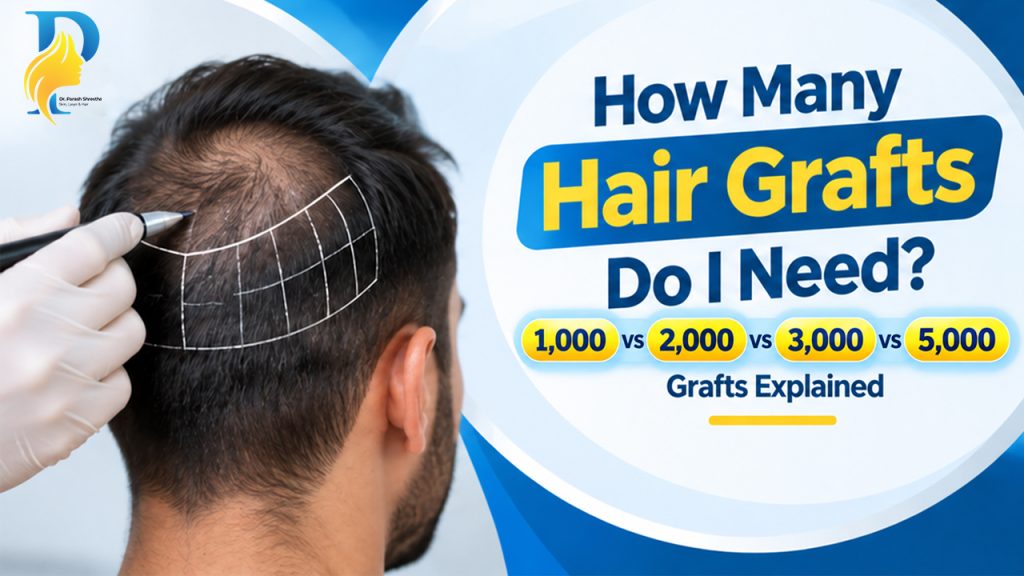
How many hair grafts do I need? There is no single number that applies to everyone. A relatively small hairline or temple correction may use around 1,000 grafts, while broader frontal, mid-scalp or crown restoration can require several thousand. But 2,000, 3,000 or 5,000 grafts should never be selected from an online package alone.
Your requirement depends on the area being treated, donor density, hair calibre, follicular-unit composition, desired coverage, existing hair and future progression of hair loss.
Just as important, your donor supply is limited. A good hair transplant in Nepal plan therefore asks two questions:
How many grafts would improve the bald area and how many can be moved safely without compromising the donor area or your future options?
What Is One Hair Graft?
A hair graft usually refers to a naturally occurring follicular unit, not one individual strand of hair.
Human scalp hair grows in small groups. One follicular unit can contain one, two, three or sometimes more hairs. Research examining donor scalp distribution found follicular-unit densities of roughly 65–85 units per square centimetre, with hair density being higher because many units contain multiple hairs.
This creates an important distinction:
2,000 grafts ≠ necessarily 2,000 hairs.
If someone’s average harvested follicular unit contains about two hairs, 2,000 grafts could represent approximately 4,000 hair shafts. Another person’s graft composition may differ.
A study examining FUE donor areas reported an average graft-to-hair ratio of about 1:2.3 in its small sample, illustrating how one graft frequently contains more than one hair. That specific ratio should not be assumed for every patient.
This is why counting grafts alone does not tell you how dense the final result will look.
What Determines How Many Hair Grafts You Need?
Your transplant plan is essentially a balance between recipient demand and donor supply.
1. Size of the bald or thinning area
A small temporal recession requires fewer grafts than reconstructing the entire frontal third of the scalp.
Adding the mid-scalp and crown increases the surface area further.
The larger the treatment area, the more carefully the available donor follicles must be distributed.
2. Where the grafts will be placed
One thousand grafts concentrated into a small hairline zone can create far more visual impact than 1,000 grafts spread across a large crown.
Therefore:
The same graft count can produce very different visual results depending on where it is used.
3. Donor density
Hair-transplant guidelines recommend assessing donor density at several points rather than assuming the back of every scalp provides the same supply. Density, hair calibre, thinning within the donor area and the limits of the safe donor zone all matter.
StatPearls describes the safe occipital donor region as commonly containing roughly 65–85 follicular units/cm², while noting that people with greater density tend to be better surgical candidates.
4. Hair shaft thickness
Coarse hair can provide greater visual coverage than fine hair because each strand occupies more apparent space.
This means two people receiving exactly 2,500 grafts may not achieve the same cosmetic density.
5. Curl and texture
Curly or wavy hair may create stronger visual coverage than very straight hair because it occupies more three-dimensional space.
6. Hair-to-scalp colour contrast
Dark hair against a very light scalp may make gaps more visible than lower-contrast combinations.
This is an aesthetic factor, not simply a follicle-count issue.
7. Existing native hair
A person with significant miniaturised but still present hair may need a different density strategy from someone with a completely bald recipient area.
Native hair can add coverage, but it can also continue to thin after surgery.
8. Future hair loss
Perhaps the most important factor is what the scalp may look like five, ten or twenty years later.
A young person with early recession may technically have enough donor hair to build an extremely low, dense hairline. But using too much donor supply early can create problems if the mid-scalp and crown later thin.
The current Dr. Parash Shrestha hair-transplant guide makes this same point: donor hair is finite and planning should prioritise long-term donor preservation rather than simply maximising today’s graft number.
1,000 vs 2,000 vs 3,000 vs 5,000 Grafts: What Can They Mean?
These examples are planning illustrations, not prescriptions. Your actual requirement can only be determined after examination of the donor and recipient areas.
| Graft number | Typical scale of treatment | Main planning consideration |
|---|---|---|
| 1,000 grafts | Small/localised correction | Concentrated coverage |
| 2,000 grafts | Moderate frontal/hairline restoration | Hairline + frontal density |
| 3,000 grafts | Broader frontal or frontal + selected mid-scalp work | Donor allocation becomes more important |
| 5,000 grafts | Extensive multi-zone restoration in selected patients | Donor safety and lifetime planning are critical |
The table should not be interpreted as “1,000 grafts equals Norwood II” or “5,000 equals Norwood VI.” Baldness grades, scalp dimensions and donor characteristics differ substantially between individuals.
What can 1,000 grafts cover?
Around 1,000 grafts can be useful for a relatively small, strategically important area rather than extensive baldness.
Examples may include selected:
- temple recession;
- modest hairline refinement;
- smaller frontal gaps;
- scar correction;
- density enhancement in a limited zone.
The important advantage of a smaller session is concentration.
If 1,000 grafts are distributed across a very large bald area, coverage may appear sparse. Used strategically around the frontal frame, the same graft supply can produce a much stronger visual effect.
Is 2,000 grafts enough?
Two thousand grafts can provide meaningful restoration for many moderate frontal cases, but whether it is “enough” depends on the surface area and desired density.
A person with frontal recession and some retained native hair may get substantially more visual benefit from 2,000 grafts than someone trying to cover frontal, mid-scalp and crown baldness simultaneously.
This is where hairline design matters.
Single-hair follicular units are generally valuable at the very front to create softness, while larger multi-hair units can be placed behind them to build visual density.
What can 3,000 grafts cover?
Three thousand grafts moves the procedure into a larger restoration strategy.
Depending on the patient, this may allow treatment of:
- a significantly receded hairline;
- much of the frontal third;
- selected frontal plus mid-scalp thinning;
- or a combination of zones prioritised according to visual importance.
But 3,000 grafts should still not be interpreted as a guarantee of “full density.”
Hair transplantation does not recreate the original adolescent follicle count. Its goal is to redistribute donor follicles in a pattern that creates the appearance of useful coverage.
This principle is reflected in transplantation literature: cosmetic fullness can be created with substantially fewer follicles than natural scalp density when grafts are distributed intelligently.
Is 5,000 grafts a lot?
Yes. A 5,000-graft plan represents a major use of donor supply and should only be considered when donor characteristics support it.
It may be relevant in selected patients with extensive hair loss, but the important question is not whether 5,000 follicles can physically be extracted.
It is:
Can that number be harvested safely while leaving an acceptable donor appearance and enough reserve for future loss?
A patient whose lifetime donor capacity is roughly 5,000–6,000 grafts is making a very different decision from someone whose density and donor characteristics offer considerably more.
Large graft numbers therefore require particularly careful donor mapping.
How Many Grafts Does the Average Person Have?
This question needs to be separated into total scalp follicular units and transplantable donor grafts.
A mathematical model of scalp distribution estimated approximately 50,000 follicular units over the scalp overall, with about 12,500 units in the theoretical permanent donor region. However, nowhere near all of those donor units should be removed. The same model estimated that roughly 6,250 follicular units could be transplantable in an average-density scenario while retaining enough donor hair to avoid obvious depletion.
A separate survey of 34 experienced hair-transplant surgeons produced similar but variable lifetime estimates. For a hypothetical average-density man expected to progress to Norwood V, the mean estimated harvestable supply was 6,404 follicular units; for anticipated Norwood VI, it was 5,393. Below-average and above-average donor density changed the estimates substantially.
Therefore, saying:
“Everyone has 6,000 available grafts”
would be incorrect.
A more accurate statement is:
Many average-density male patients may have a lifetime transplantable scalp donor supply measured in several thousand follicular units, often around the 5,000–6,500 range in published models, but individual capacity can be significantly lower or higher.
Why Your Donor Area Should Be Treated Like a Lifetime Graft Budget
Hair follicles removed from the donor area do not regenerate there.
That makes donor management one of the most important parts of transplantation.
Suppose two hypothetical patients both need frontal restoration.
Patient A uses 3,500 grafts to create a very low, dense hairline at age 27.
Patient B uses 2,200 grafts to build a more conservative adult hairline and retains a larger reserve.
If both later develop crown and mid-scalp loss, Patient B may have more donor flexibility for future work.
These are hypothetical examples, but the planning principle is medically important.
The American Academy of Dermatology also notes that hair loss can continue after a transplant and that ongoing treatment may be recommended to preserve remaining native hair.
This is why “maximum grafts” is not necessarily a positive selling point.
Hairline vs Crown: Which Needs More Grafts?
There is no universal answer because the size of the areas differs.
But the two zones behave differently from a design perspective.
Hairline and frontal area
The frontal hairline has very high visual importance.
It frames the face, so even a moderate number of grafts can produce a noticeable cosmetic change when placed carefully.
Hairline transplantation also requires attention to:
- irregularity;
- age-appropriate height;
- temple recession;
- single-hair grafts;
- direction and angle;
- long-term progression.
Current hair-transplant literature emphasises thoughtful hairline design and preservation of future options.
Crown or vertex
The crown can consume grafts quickly because the area may be large and the hairs radiate in a whorl pattern.
This is one reason many surgeons prioritise the frontal frame before committing a large portion of the donor reserve to the crown.
StatPearls specifically cautions that focusing only on the vertex in progressive baldness can consume donor grafts and produce an unnatural isolated ring of transplanted hair if surrounding native hair later disappears.
Is 5,000 Grafts Safe in One Hair Transplant?
A number such as 5,000 cannot be declared safe or unsafe without examining the patient.
Safety depends on:
- total safe donor area;
- density per cm²;
- hair calibre;
- extraction distribution;
- whether FUE or FUT is used;
- previous transplant history;
- donor miniaturisation;
- scalp characteristics;
- long-term baldness pattern.
Practice guidelines advise avoiding FUE overharvesting and describe a general single-pass recommendation around 10–15 excisions/cm² in an average-density donor area of approximately 65–75 follicular units/cm².
That does not mean every centimetre of donor scalp should automatically have 10–15 units removed. It is a general guidance point illustrating why donor density must be assessed and extraction distributed carefully.
A 2026 review of FUE complications lists donor depletion among recognised complications and highlights technique, follicular-unit density and graft handling as factors influencing outcomes.
Therefore, asking only:
“Can your clinic do 5,000 grafts?”
is less useful than asking:
“What is my measured donor density, what percentage would be harvested, and what donor reserve would remain afterward?”
Can Too Many Grafts Be Taken?
Yes.
Excessive harvesting can lead to:
- visibly thin donor areas;
- patchy extraction patterns;
- hypopigmented dots;
- scarring;
- limited graft supply for future procedures.
Modern practice guidelines explicitly warn against overharvesting.
The problem is particularly important in FUE because the individual punch scars may be small, but thousands of extractions collectively reduce hair mass.
A small study assessing donor changes after FUE found that extracted hair represented about 35% of baseline hair density in the sampled areas and concluded that FUE should be performed cautiously because donor density varies.
The exact safe extraction fraction should not be generalised from one small study. The larger lesson is that donor hair is measurable and finite.
Does More Grafts Mean a Better Result?
No.
A higher graft count may be required when the treatment area is larger, but more grafts do not automatically equal:
- better hairline design;
- higher survival;
- more natural direction;
- safer donor harvesting;
- better long-term appearance.
Research on dense packing also notes that not every patient is suitable for very high recipient densities.
The outcome depends on how effectively available grafts are used.
A well-designed 2,000-graft frontal restoration can be cosmetically stronger than a poorly distributed 3,500-graft procedure.
How Does a Hair Transplant Doctor Calculate the Number of Grafts?
A responsible estimate involves more than looking at a photograph.
Step 1: Confirm the diagnosis
Hair transplant surgery is mainly used for appropriately selected permanent hair loss such as androgenetic alopecia.
Sudden shedding, inflammatory scalp disease, alopecia areata or diffuse hair loss may need treatment before transplantation is considered.
If your main issue is recent or unexplained thinning, review the causes of hair thinning and common causes of hair fall in men and women before assuming surgery is the next step.
Step 2: Measure the recipient area
The surgeon evaluates the size of the zones requiring coverage.
This may include:
- temporal recession;
- frontal hairline;
- frontal scalp;
- mid-scalp;
- vertex/crown.
Step 3: Measure donor density
The donor should be examined at several points.
Follicular-unit density, hair shaft diameter, miniaturisation and safe donor boundaries all influence how many grafts can be removed. Practice guidelines specifically recommend detailed donor examination and trichoscopic assessment where appropriate.
Step 4: Evaluate follicular-unit composition
A donor area containing a favourable proportion of two-, three- and multi-hair units may produce more hair shafts from a given graft number than a donor area dominated by single-hair units.
Step 5: Decide aesthetic priorities
If donor supply cannot densely cover every bald area, priority becomes important.
For many patients:
framing the face → frontal density → mid-scalp → crown
may produce greater visual impact than spreading grafts equally everywhere.
But this needs individual planning.
Step 6: Reserve grafts for the future
A strong plan asks not only:
How many grafts can I transplant today?
but:
How many should I avoid using today?
That distinction becomes increasingly important in younger patients and those with progressive androgenetic alopecia.
Can an Online Hair Graft Calculator Tell Me Exactly What I Need?
No.
A calculator can help you understand how area × desired graft density influences the approximate number, but it cannot assess:
- donor miniaturisation;
- hair calibre;
- future hair loss;
- curl;
- follicular-unit distribution;
- scalp disease;
- prior extraction;
- safe donor boundaries.
Use an online graft calculator as an educational tool, not a surgical prescription.
The site’s current hair transplant cost guide makes the same point: an online calculator cannot examine donor density, miniaturisation or future progression.
How Much Does One Hair Graft Cost in Nepal?
There is no official national price per graft.
Dr. Parash Shrestha’s current cost guide reviewed selected publicly advertised Nepal prices in September 2026 and found examples ranging roughly from NPR 35 to NPR 85 per graft. Those figures are market examples from other providers, not Dr. Shrestha’s own published fee or an official national average.
For detailed examples covering 1,000 through 5,000 grafts, use the dedicated hair transplant cost per graft in Nepal guide.
Keeping detailed pricing on that page is also better for SEO because it prevents this graft-estimation article from competing with the cost page.
Common Mistakes When Comparing Graft Packages
Choosing the biggest number
“5,000 grafts” sounds more impressive than “2,500 grafts,” but the correct quantity is determined by donor supply and recipient need.
Assuming one graft equals one hair
A follicular unit can contain multiple hairs.
Comparing patients only by baldness grade
Two people with similar Norwood patterns can have different scalp dimensions, density, hair calibre and donor capacity.
Ignoring future hair loss
A transplant only moves follicles. It does not stop untreated native hair from thinning.
Using all donor supply in the first procedure
A donor reserve may become important if additional areas thin later.
Choosing purely by price per graft
A low price does not tell you:
- who designed the hairline;
- how donor density was assessed;
- how grafts are distributed;
- whether overharvesting was avoided;
- how future loss was planned.
How Should You Choose a Hair Transplant Clinic in Kathmandu?
If a clinic tells you that you need exactly 4,000 or 5,000 grafts after looking at one photograph, ask how the number was calculated.
A useful consultation should explain:
- your diagnosis;
- donor density;
- size of the treatment area;
- why the proposed graft count is appropriate;
- which zones receive priority;
- how much donor reserve remains;
- whether future procedures may be needed;
- what medical treatment may help preserve native hair.
The American Academy of Dermatology emphasises that results depend substantially on the surgeon selected and that a dermatologist can determine whether someone is an appropriate candidate through scalp examination and, when needed, additional diagnostic testing.
Dr. Parash Shrestha’s website identifies him as a Consultant Dermatologist in Nepal with MBBS, MD and FAM qualifications, NMC No. 7527, specialised training in hair-transplant surgery and 15+ years of dermatology experience.
Patients comparing providers can also review the guide to choosing a dermatologist in Nepal.
A Better Way to Think About Graft Numbers
Instead of asking:
“Do I need 3,000 grafts?”
ask four questions:
1. How large is the area I want restored?
2. How many grafts can my donor area safely provide?
3. Where will each graft create the greatest visual benefit?
4. How much donor supply should remain for future hair loss?
Those questions turn graft counting into long-term hair-restoration planning.
Key Takeaways
There is no universal answer to how many hair grafts do I need.
Approximately:
- 1,000 grafts may suit a limited correction.
- 2,000 grafts may provide meaningful frontal restoration in selected cases.
- 3,000 grafts can support broader frontal or multi-zone planning.
- 5,000 grafts represents a major use of donor supply and requires particularly careful donor assessment.
These are examples, not prescriptions.
Published models suggest that an average-density male donor area may provide a lifetime transplantable supply measured around several thousand follicular units, commonly in the 5,000–6,500 range, but individual variation is large.
The best graft number is therefore not the biggest number a clinic can sell.
It is the number that creates useful coverage while protecting the donor area and keeping future options open.
For people considering a hair transplant in Nepal, a scalp and donor-area assessment can provide a personalised graft estimate before deciding on surgery.
Medical disclaimer: This article provides general educational information. It cannot determine an individual’s graft requirement, donor capacity or suitability for hair-transplant surgery. Those decisions require clinical examination and personalised surgical planning.
FAQs
How many hair grafts do I need?
The number depends on the size and location of your thinning area, donor density, hair calibre, follicular-unit composition and future hair-loss pattern. A small hairline correction may need around 1,000 grafts, while extensive multi-zone restoration may require several thousand. A personalised estimate requires examination of both donor and recipient areas.
Is 1,000 hair grafts enough?
It can be enough for a limited area such as selected temple recession, modest hairline refinement or a smaller focal zone. It is generally not enough to create dense coverage across extensive frontal, mid-scalp and crown baldness. The result depends more on the surface area and distribution than the number alone.
Is 2,000 grafts a lot?
Two thousand grafts is a meaningful transplant session and may provide useful coverage in selected frontal or hairline cases. Whether it is enough depends on the recipient area, existing native hair, donor characteristics and the density goal.
Is 3,000 grafts enough for a full hair transplant?
Three thousand grafts may provide substantial frontal or selected multi-zone restoration, but it does not automatically provide full-scalp density. Extensive baldness can require prioritisation because donor follicles are limited.
Is 5,000 grafts safe?
Five thousand grafts may be appropriate for selected patients with strong donor density, but the number cannot be declared safe without donor assessment. Overharvesting can cause visible thinning and donor depletion, so extraction density and lifetime donor reserve must be considered.
How many grafts does the average person have available?
Published models and surgeon estimates suggest that an average-density male patient may have roughly 5,000–6,500 scalp follicular units potentially available over a lifetime, depending on the future baldness pattern and donor characteristics. This should not be interpreted as a guaranteed personal donor supply.
Is one graft the same as one hair?
No. A graft usually represents a follicular unit that may contain one or several hairs. Therefore, 2,000 grafts can contain significantly more than 2,000 individual hair shafts.
How many hairs are in 3,000 grafts?
There is no fixed number because follicular units contain different numbers of hairs. If an individual’s average graft contained approximately two hairs, 3,000 grafts would represent around 6,000 hair shafts, but actual graft composition must be counted rather than assumed.
How many grafts are needed for the crown?
It depends mainly on crown size, existing hair and desired density. A crown can consume a large number of grafts because of its surface area and whorl pattern. Long-term plans often prioritise donor conservation rather than attempting maximum crown density.
How many grafts are needed for a receding hairline?
A small recession may require around 1,000 or more grafts, while a broader frontal reconstruction may require considerably more. Hairline position, temporal recession, width of the frontal zone and donor characteristics all change the estimate.
How much does one hair graft cost in Nepal?
There is no official national per-graft fee. Dr. Parash Shrestha’s September 2026 cost guide reviewed selected publicly advertised Nepal rates ranging roughly from NPR 35–85 per graft, but those are market examples rather than his own published fee or a national standard.
Can I calculate my own graft requirement from the Norwood scale?
You can obtain a rough idea, but the Norwood scale alone is insufficient for surgical planning. People with the same Norwood grade can have different scalp sizes, donor density, hair calibre, hair-to-scalp contrast and future progression.
Can donor hair run out?
Yes. Transplantable donor follicles are finite. Excessive harvesting or poorly planned early procedures can reduce the options available if additional native hair is lost later.
Author Bio
Dr. Parash Shrestha, MBBS, MD, FAM, NMC No. 7527, is a Consultant Dermatologist in Nepal. His official professional website states that he has specialised training in clinical dermatology, cosmetic dermatology, laser treatments and hair-transplant surgery, with more than 15 years of experience managing skin and hair concerns. His hair-restoration approach emphasises diagnosis, donor planning and long-term management of hair loss.