
A visible scar can come from acne, an injury, surgery, burns or another wound. Some scars are flat but discoloured, some are depressed, some become thick and raised, and others can pull on the surrounding skin and restrict movement.
Because scars behave differently, scar removal is not one single treatment.
Scar revision aims to make a scar less noticeable, smoother, flatter, better blended with the surrounding skin or less restrictive. Depending on the scar, treatment may involve medical scar care, injections, microneedling, laser or light procedures, resurfacing techniques or surgical revision.
A scar generally cannot be guaranteed to disappear completely. The American Society of Plastic Surgeons describes scar revision as treatment intended to make a scar less conspicuous rather than erase it entirely.
For patients considering scar revision in Nepal, the first step should therefore be identifying the scar correctly rather than choosing a procedure based on an advertisement, package or before-and-after photograph.
Dr. Parash Shrestha is a Consultant Dermatologist and Venereologist in Nepal with MBBS, MD and FAM qualifications and Nepal Medical Council registration No. 7527. His professional scope includes medical dermatology, cosmetic dermatology and laser procedures.
What Is Scar Revision?
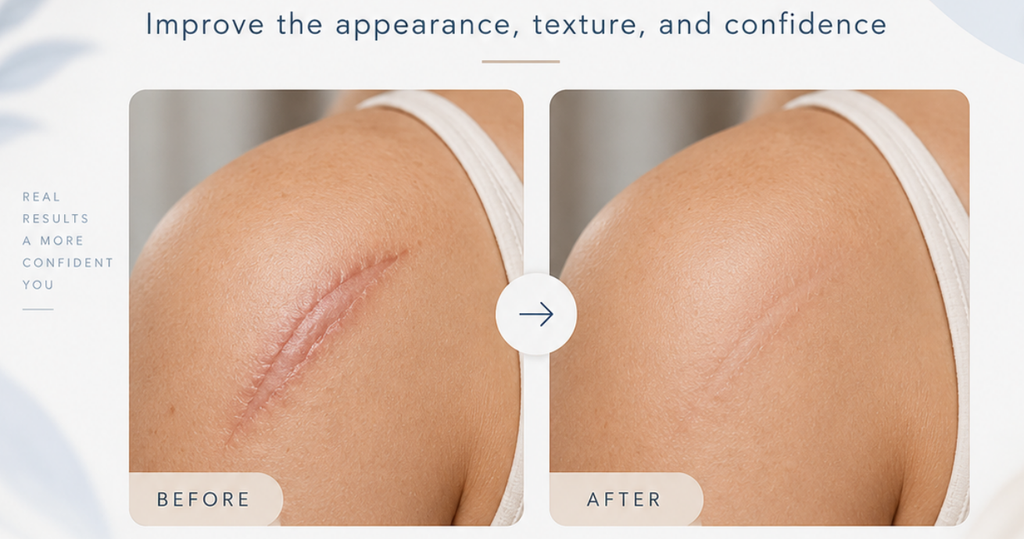
Scar revision refers to treatments used to improve the appearance or function of an existing scar.
The treatment objective depends on what makes the scar noticeable.
A wide surgical scar may need a different approach from a raised keloid. A tethered acne scar needs different treatment from a dark mark left after a pimple. A scar crossing a joint may require attention to movement as well as appearance.
The American Academy of Dermatology recommends identifying the type of scar before treatment because scar type, age and duration can affect treatment selection.
That is why a useful scar assessment examines more than its size.
A dermatologist may consider the scar’s:
- cause
- age
- location
- width and depth
- colour
- texture
- whether it is raised or depressed
- symptoms such as itching or discomfort
- effect on movement
- previous treatments
- surrounding skin
- and the patient’s healing history and goals.
Scar Removal vs Scar Revision: What Results Are Realistic?
The term scar removal is commonly used by patients searching online, but “removal” can create unrealistic expectations.
Scar treatments generally aim to reduce visibility or improve a particular feature of the scar.
For example:
- laser may reduce redness, texture irregularity or the visibility of selected scars
- microneedling may improve selected depressed scars
- injections may help flatten certain raised scars
- surgery may replace an unfavorable scar with a better-positioned or finer scar
- silicone products may help certain raised scars
- combination treatment may be appropriate when a scar has more than one problem.
The AAD specifically cautions that laser treatment can make scars less noticeable but does not simply make a scar disappear.
A trustworthy treatment plan therefore starts with what can reasonably be improved, not with a promise of complete scar removal.
Types of Scars and Why the Type Matters
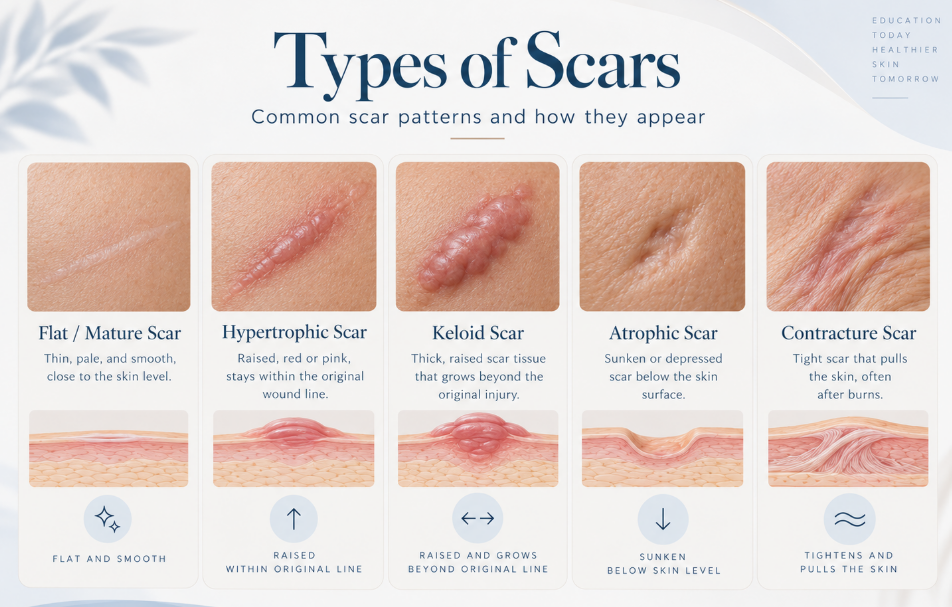
Surgical and traumatic scars
Cuts, accidents and operations can leave scars that become wide, depressed, elevated, irregular or differently coloured from surrounding skin.
Some may respond to nonsurgical management. Others may be considered for surgical revision when the position, width, orientation or tissue characteristics make surgery more appropriate.
Atrophic or depressed scars
An atrophic scar sits below the surrounding skin because of tissue loss.
Acne is a common cause, although injury and certain infections can also leave depressed scars.
Treatments that stimulate collagen, release tethering or restore lost volume may be considered depending on the individual scar.
Hypertrophic scars
A hypertrophic scar is raised because excess scar tissue develops during healing, but it generally remains within the original wound boundary.
Treatment may involve silicone, injections, laser or other scar-directed approaches depending on its maturity and characteristics.
Keloid scars
Keloids are raised scars that grow beyond the original wound margin.
They deserve particular care because recurrence can be difficult to control. The AAD notes that keloid treatment often uses more than one method and that surgery alone carries a substantial risk of recurrence.
For that reason, a keloid should not be treated as if it were simply a thick ordinary scar.
Scar contractures
Some scars become tight enough to restrict movement, particularly after significant tissue injury or burns.
Scar revision can sometimes be used to improve flexibility as well as appearance. Surgical techniques such as flap rearrangement or Z-plasty may be considered in appropriately selected cases.
Acne scars
Acne scars commonly include depressed patterns known as ice-pick, boxcar and rolling scars. Acne can also produce raised hypertrophic or keloid scars.
DermNet describes the three major atrophic acne-scar patterns as ice-pick, rolling and boxcar scars.
A person can have several scar types on the same face, which is one reason a single procedure may not address every scar equally well.
Is It a Scar or a Dark Mark?
This distinction matters.
A flat brown, red or grey mark remaining after inflammation is not necessarily the same thing as a permanent structural scar.
A true depressed scar changes the surface contour of the skin. A raised scar protrudes above it. Pigmentation mainly changes colour.
This means someone searching for “scar removal” may actually need treatment for post-inflammatory pigmentation rather than scar revision.
Dr. Parash has a separate guide explaining why pimples can leave dark marks after healing.
Correctly identifying the problem prevents unnecessary procedures.
Which Scar Treatment May Be Appropriate?
There is no universally “best scar treatment.”
A useful framework is:
| Scar feature | Treatment approaches a dermatologist may consider | Main objective |
|---|---|---|
| Wide or unfavorable surgical/traumatic scar | Surgical revision ± additional scar management | Create a less conspicuous scar |
| Depressed acne scar | Microneedling, laser, scar-specific procedures or combination treatment | Improve depth and texture |
| Ice-pick acne scar | Focal techniques such as TCA CROSS or other scar-specific procedures | Treat deep narrow depressions |
| Rolling/tethered scar | Release/remodelling procedures ± resurfacing | Improve tethering and contour |
| Raised hypertrophic scar | Silicone, injections, laser or other scar management | Flatten and reduce symptoms |
| Keloid | Usually multimodal treatment | Reduce bulk/symptoms and recurrence |
| Red or discoloured scar | Selected laser/light or pigmentation-directed treatment | Improve colour |
| Scar restricting movement | Surgical assessment | Improve function |
| Flat post-acne dark mark | Pigmentation treatment rather than surgical scar revision | Improve colour |
This table is educational, not a treatment prescription. Suitability depends on examination, medical history, skin characteristics, previous treatment and the exact scar.
Scar Revision Surgery in Nepal
Scar revision surgery may be considered when the shape, width, location or physical characteristics of a scar make a surgical approach appropriate.
The principle is not to “delete” the body’s ability to scar. Instead, a surgeon may remove or reposition unfavorable scar tissue and close the wound using techniques intended to produce a more favorable scar.
The American Society of Plastic Surgeons describes scar-revision procedures ranging from simple scar excision and layered closure to more advanced flap techniques and Z-plasty for selected scars.
What happens during scar revision surgery?
The exact procedure depends on the scar.
Local anaesthesia may be enough for some procedures, while other cases may require sedation or general anaesthesia. The old scar may be excised, and the wound may be closed in layers. More complex scars can require techniques designed to change scar direction, reduce tension or improve mobility.
Not every scar benefits from surgery.
A consultation should answer:
Will surgery create a meaningfully better scar than the one already present?
That is more useful than asking whether surgery can “remove” the scar.
Who May Be Considered for Surgical Scar Revision?
Possible candidates include people with a mature scar that is:
- wide or conspicuous
- poorly positioned
- uneven or distorted
- causing functional tightness
- cosmetically troublesome
- or potentially better suited to surgical correction than surface treatment.
Timing matters because scars continue to change while healing.
The final appearance of a newly revised scar may take many months to develop. ASPS notes that some scars can continue to mature and fade for up to a year following revision.
A dermatologist or surgeon should therefore decide whether immediate treatment, continued observation or another form of scar management is appropriate.
Laser Scar Removal in Nepal: What Laser Can and Cannot Do
Laser treatment is useful for selected scars, but “laser scar removal” should not be interpreted as complete erasure.
Different laser and light technologies target different problems. Depending on the technology and scar, treatment may aim to improve:
- redness
- pigmentation
- texture
- thickness
- itching
- discomfort
- or selected depressed scars.
The AAD notes that lasers can make many scars less noticeable and can sometimes improve symptoms or movement, but outcomes depend heavily on scar characteristics, skin type and treatment technique.
Is CO₂ laser always the best scar treatment?
No.
Fractional CO₂ laser is an important resurfacing treatment for selected scars, including some atrophic acne scars, but it is not automatically appropriate for every scar or every skin type.
Recent evidence comparing fractional CO₂ laser with needling-based treatments for atrophic acne scars found comparable overall efficacy in some outcomes but a higher risk of post-inflammatory hyperpigmentation with fractional CO₂ laser than standard microneedling. Treatment choice therefore needs to consider scar pattern, skin type, downtime and complication risk.
The correct question is not:
“Which laser is strongest?”
It is:
“Which procedure offers the best balance of improvement and risk for this particular scar and skin?”
Acne Scar Treatment in Nepal
Acne scar treatment deserves its own assessment because acne rarely creates only one uniform scar.
Atrophic acne scars include:
Ice-pick scars: narrow and deep.
Boxcar scars: broader depressions with more defined edges.
Rolling scars: shallower undulations often associated with fibrous tethering underneath the skin.
Patients can also develop raised hypertrophic scars or keloids.
Because the structure differs, treatment needs to be matched to the scar rather than applied uniformly to the entire face.
Common acne scar treatment approaches
Depending on the scar pattern and patient, dermatologists may consider approaches including:
Microneedling: creates controlled micro-injuries to stimulate collagen remodelling. The AAD lists acne scars, surgical scars and injury scars among its dermatologic uses.
Fractional laser resurfacing: can improve selected atrophic scars. Evidence suggests effectiveness varies according to scar type, treatment settings, number of sessions and skin phototype.
TCA CROSS: applies high-concentration trichloroacetic acid focally to selected atrophic scars, particularly narrow/deep scars. Complete resolution should not be expected from the technique alone.
Subcision and other scar-release procedures: may be considered when depressed scars are tethered to deeper tissue.
Fillers: may be considered for selected depressed scars where restoring volume is appropriate.
Combination treatment: may be useful when several scar types occur together. A systematic review of acne-scar management concluded that treatment choice should reflect scar type and severity and that combination approaches can outperform single-modality treatment in appropriately selected patients.
Treat active acne as well as the scars
If new inflammatory acne is continuing to form, treating existing scars without controlling the acne can result in new scars developing during the treatment process.
Dr. Parash’s guide to adult acne treatment and scar prevention explains why active acne and established scars need different management.
Can Scar Removal Cream Remove an Old Scar?
Usually, a cream cannot simply erase a mature structural scar.
That does not mean every topical scar product is useless.
Silicone gel or silicone sheets can have a role in certain raised scars and in scar management after wounds have appropriately healed. The AAD notes that silicone products may help reduce features such as the size, hardness, redness, swelling or stiffness of some raised scars.
But the treatment needs to match the problem.
A cream cannot mechanically release a tethered rolling scar. It cannot surgically narrow a wide scar. And it cannot replace missing tissue in a deep atrophic scar in the same way an appropriate procedure may.
This is why people searching for scar removal cream in Nepal should first determine whether they have:
- pigmentation
- a raised scar
- a depressed scar
- or a wide structural scar.
Those are different problems.
Avoid applying potent prescription creams, acids or unregulated “scar removal” products without appropriate medical guidance, particularly to irritated or incompletely healed skin.
Scar Revision Surgery Cost in Nepal
The cost of scar revision surgery in Nepal cannot be accurately calculated from the word “scar” alone.
Important cost factors can include:
- scar size
- number of scars
- location
- depth
- whether the scar is raised, depressed or contracted
- complexity of excision and closure
- type of anaesthesia
- treatment facility
- whether more than one procedure is required
- medicines and dressings
- follow-up
- and whether additional laser, injection or other treatment is recommended.
Some Nepal clinics publish per-centimetre scar-revision pricing, which indicates that cost is an important part of patient decision-making. However, copying another clinic’s pricing would be misleading because fees, inclusions and treatment protocols differ.
An accurate scar revision cost is provided after the scar has been assessed and the required procedure, anaesthesia and follow-up have been determined.
Laser Scar Removal Cost in Nepal
Laser scar treatment cost also depends on the exact procedure rather than simply the existence of a scar.
Factors include:
- laser technology selected
- treatment area
- type and severity of scar
- number of treatment sessions
- anaesthetic requirements
- whether combination treatment is used
- and aftercare.
Some patients may need multiple laser sessions, while others may be better suited to a different treatment entirely. The AAD specifically notes that more than one treatment can be required, particularly with some non-ablative lasers.
Patients should therefore request an assessment rather than choosing treatment solely on a price-per-session comparison.
What Happens During a Scar Consultation?
A scar consultation should answer three questions:
1. What exactly is the scar?
The doctor determines whether it is primarily:
- depressed
- raised
- keloidal
- wide
- pigmented
- red
- tethered
- or functionally restrictive.
2. What part of it can realistically be improved?
The treatment objective might be reducing width, flattening, improving texture, reducing colour contrast, improving mobility or making the scar blend more naturally.
3. Which treatment has the most appropriate risk-benefit balance?
Only after those questions are answered does the choice between laser, microneedling, injection, surgery, topical care or combination treatment become useful.
This is why the AAD recommends medical assessment before laser scar treatment and stresses the importance of considering skin type, scar characteristics and medical history.
Recovery After Scar Revision
Recovery varies considerably with the treatment.
After surgical scar revision
ASPS states that the early healing phase can involve localized swelling, discoloration or discomfort for around one to two weeks. Healing then continues for several weeks, while the revised scar can gradually refine over months. In some cases, the final appearance takes up to a year.
After laser or resurfacing procedures
Recovery depends on the treatment depth and technology.
Redness, sensitivity and other temporary skin changes can occur, and careful aftercare is important. Sun exposure can worsen unwanted pigment changes after some procedures, making sun protection particularly important when advised by the dermatologist.
Patients should follow the personalised instructions they receive rather than copying another person’s post-procedure routine.
Risks and Limitations of Scar Treatment
Scar revision is medical treatment, and meaningful limitations should be discussed before deciding to proceed.
Possible risks of surgical scar revision can include:
- bleeding
- infection
- delayed or poor wound healing
- altered sensation
- pigmentation changes
- persistent discomfort
- an unfavorable new scar
- unsatisfactory cosmetic improvement
- or the need for further revision.
ASPS lists these and other procedure-specific risks and emphasises that surgical outcomes cannot be guaranteed.
Laser and other procedures have their own risks, which can include redness, pigment alteration and other treatment-specific complications.
Keloids require particular caution because recurrence is common.
Discuss both expected improvement and potential downsides before proceeding.
When Should You See a Dermatologist About a Scar?
Consider professional assessment when a scar:
- is thickening or growing
- becomes painful or persistently itchy
- extends beyond the original wound
- restricts movement
- remains significantly raised or depressed
- changes in a way you do not understand
- follows severe acne that is still active
- causes ongoing cosmetic concern
- or has not responded to treatments you have already tried.
Seek prompt medical assessment rather than cosmetic treatment if the area is open, infected, repeatedly bleeding or otherwise behaving like an active skin lesion rather than a stable scar.
Why Consult Dr. Parash Shrestha for Scar Assessment in Nepal?
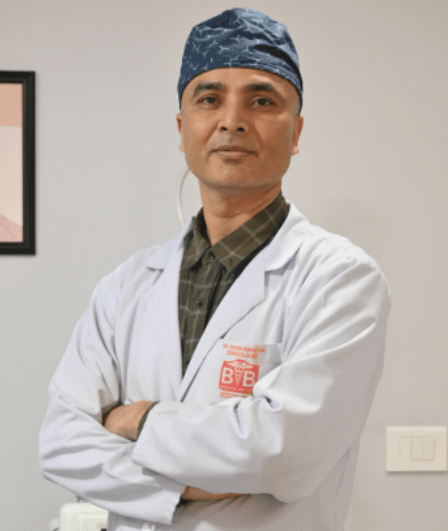
Dr. Parash Shrestha is a Consultant Dermatologist & Venereologist with MBBS, MD and FAM qualifications and NMC registration No. 7527. B&B Hospital independently confirms his specialist position and credentials.
His documented practice encompasses medical dermatology, cosmetic dermatology and laser procedures, allowing scar assessment to begin with diagnosis rather than automatically starting with a cosmetic procedure.
That distinction matters.
For scar revision, the important question is not merely which device is available. It is whether the problem is structural, inflammatory, pigmentary, raised, depressed or surgical—and which approach is appropriate for that specific scar.
Learn more about Dr. Parash Shrestha and his dermatology practice.
Frequently Asked Questions About Scar Revision in Nepal
Can scars be completely removed?
Usually not. Treatment aims to make a scar less noticeable or improve features such as width, depth, colour, texture, thickness or restriction. Both AAD and ASPS guidance caution against interpreting scar treatment as complete erasure.
What is the best treatment for an old scar?
There is no single best treatment for all old scars. The answer depends on whether the scar is depressed, raised, wide, pigmented, tethered, keloidal or causing functional restriction.
Is laser better than scar revision surgery?
Neither is universally better. Laser can be useful for selected colour and texture problems, while surgical revision may be more suitable for certain wide, poorly positioned or structurally unfavorable scars. Some patients benefit from staged or combination treatment.
Can laser completely remove a scar?
No. Laser can make selected scars less noticeable, but the AAD explicitly states that it does not simply eliminate the scar.
Can acne scars be treated?
Yes, many acne scars can be improved. Treatment depends on whether the scar is ice-pick, boxcar, rolling, raised or mixed. Microneedling, focal chemical techniques, laser, scar-release procedures and other approaches may be considered after assessment.
Should active acne be treated before acne scar treatment?
Usually, controlling ongoing acne is an important part of the plan because new inflammatory lesions can create new scars. Treatment sequencing should be determined individually.
Can scar removal cream fix deep acne scars?
Topical products have limited ability to correct deep structural depressions. Silicone can help selected raised scars, while pigmentation may respond to other topical treatment, but deep or tethered acne scars often require procedural assessment.
Can keloids return after treatment?
Yes. Keloids have a significant tendency to recur, particularly when treated by surgery alone. Dermatologists therefore commonly use combination treatment strategies.
How many sessions are needed for laser scar treatment?
There is no universal number. It depends on laser type, scar type, treatment area, skin characteristics, response and treatment goals. Some laser approaches require multiple sessions.
How long does scar revision take to heal?
Early surgical healing may take approximately one to two weeks, but scar maturation continues much longer. Final refinement may require several months and sometimes up to a year.
How much does scar revision surgery cost in Nepal?
Cost varies with the scar, procedure, location, anaesthesia and follow-up requirements. Dr. Parash’s current fee should be confirmed directly with the clinic rather than estimated from another provider’s price.
Book a Scar Assessment With Dr. Parash Shrestha
If you are unsure whether you need laser treatment, surgical revision, acne-scar treatment or another approach, begin with a dermatological assessment.
Bring information about:
- how the scar occurred
- when it developed
- whether it has changed
- previous treatments
- medications and health conditions relevant to healing
- and what specifically you would like to improve.
A consultation can then establish the scar type, realistic treatment goals, suitable options, likely recovery and current treatment cost.
Dr. Parash Shrestha
Consultant Dermatologist & Venereologist
MBBS, MD, FAM
NMC No. 7527
Nava Derma, New Baneshwor: +977-9851145556
B&B Hospital, Gwarko, Lalitpur: 01-5970999
Medical note: This page provides general educational information and does not replace an individual medical examination, diagnosis or treatment plan.