
Laser Hair Removal in Kathmandu
Laser hair removal uses focused light to reduce unwanted facial or body hair. Dr. Parash Shrestha provides dermatologist-led assessment for patients considering laser hair removal in Kathmandu, with consultation access listed at Nava Derma in New Baneshwor. Treatment suitability, expected results and risks depend on your skin tone, hair colour, medical history and the area being treated.
Dr. Parash Shrestha is a Consultant Dermatologist and Venereologist in Kathmandu with MBBS, MD and FAM qualifications and NMC registration No. 7527. His official website lists dermatological laser procedures for hair removal, with a Kathmandu practice at Nava Derma in New Baneshwor. A consultation is required to determine whether laser treatment is appropriate for your skin and hair.
Request a laser hair removal assessment: Call Nava Derma at +977-9851145556 to confirm the treatment location, schedule and current cost.
What is laser hair removal?
Laser hair removal is a procedure that directs controlled light energy toward pigment, called melanin, in the hair. The absorbed energy heats the hair-producing structure and may reduce its ability to grow another hair.
Laser treatment is most effective when enough pigment is present in the hair for the device to target. Dark, coarse hair often responds more predictably than white, grey, very light blond or some fine hair. Technology and settings must also be selected carefully for the patient’s skin tone.
The procedure does not remove every hair in one visit. Hair follicles pass through different growth phases, and laser treatment is generally most effective during the active growth phase. This is why a treatment course normally involves several appointments rather than one session. The American Academy of Dermatology notes that many patients need multiple treatments and that regrowth, when it occurs, may be finer and less noticeable.
Who may benefit from laser hair removal?
Laser hair removal may be considered by adults who:
- Want longer-lasting reduction of unwanted facial or body hair
- Experience repeated shaving irritation
- Develop razor bumps or ingrown hairs
- Find frequent waxing, threading or shaving inconvenient
- Have dark, visible hair that is likely to respond to laser energy
- Understand that several sessions and possible maintenance may be needed
- Have realistic expectations about reduction rather than guaranteed lifelong removal
Dermatologists use hair-removal lasers on common areas including the upper lip, chin, face, neck, underarms, back, chest, shoulders, legs and bikini area. The exact area and treatment boundary should be agreed during consultation.
When is medical evaluation important before treatment?
Not every unwanted-hair concern should begin with a cosmetic procedure. A dermatologist may recommend further assessment when hair growth:
- Appears suddenly
- Is increasing rapidly
- Is accompanied by irregular periods, acne or scalp thinning
- Develops after starting a medicine
- Occurs with other hormonal symptoms
- Is associated with an active rash, infection or unexplained skin lesion
Laser may reduce visible hair without addressing an underlying hormonal or medical cause. New hair can continue to develop when hormonal stimulation remains active, particularly on the face. The NHS similarly advises that longer-lasting hair-removal treatments are not permanent for everyone and that results vary.
Candidate and caution guide
| Patient situation | Likely next step |
|---|---|
| Dark, coarse unwanted hair with healthy skin | Consultation for laser suitability |
| Recurrent shaving bumps or ingrown hair | Dermatology assessment; laser may be considered |
| White, grey or very light hair | Discuss limited laser response and alternatives |
| Recent tanning or sunburn | Delay treatment until the clinician confirms it is safe |
| Active infection, rash or open wound | Treat or evaluate the skin problem first |
| Sudden facial or body-hair increase | Consider medical or hormonal assessment |
| History of keloids or abnormal scarring | Discuss the additional risk before proceeding |
| Taking medicines that affect light sensitivity or healing | Medication review is required |
| Pregnancy or breastfeeding | Ask the clinician whether treatment should be postponed |
| Expectations of guaranteed permanent removal | Reconsider expectations before buying a package |
A consultation should determine whether treatment is appropriate, whether a test area is needed and whether another hair-removal method would be more suitable.
How does the laser hair removal evaluation work?
Medical and treatment history
The dermatologist or clinical team should ask about:
- Previous hair-removal treatments
- Tanning and recent sun exposure
- Skin reactions, burns or pigment changes
- Keloid or raised-scar history
- Cold sores or genital-herpes outbreaks
- Current medicines and supplements
- Previous or current isotretinoin use
- Hormonal symptoms
- Pregnancy status where relevant
- Your desired treatment area and expected result
The AAD advises patients to disclose recent tanning, keloid tendency, herpes history, isotretinoin and other medicines before treatment.
Skin and hair assessment
The clinician should examine:
- Natural and current skin tone
- Recent tanning
- Hair colour
- Hair thickness and density
- Treatment-area sensitivity
- Active inflammation, infection or lesions
- Any features suggesting an underlying medical condition
Treatment planning
The treatment plan should explain:
- Whether laser is expected to work for your hair colour
- Which technology will be used
- Why that technology is appropriate for your skin
- Whether a patch test is advised
- Expected number and spacing of sessions
- Common side effects
- Less common complications
- Estimated cost and package conditions
- What maintenance may be required
Considering treatment? Request an assessment before paying for a multi-session package. Ask the clinic to document the device, operator, planned area, number of sessions, inclusions and cancellation conditions.
What happens during laser hair removal?
Before treatment, the area is assessed and cleaned. Depending on the clinic’s instructions, patients may be asked to shave the area while avoiding waxing, threading or plucking, because those methods remove the hair structure the laser needs to target.
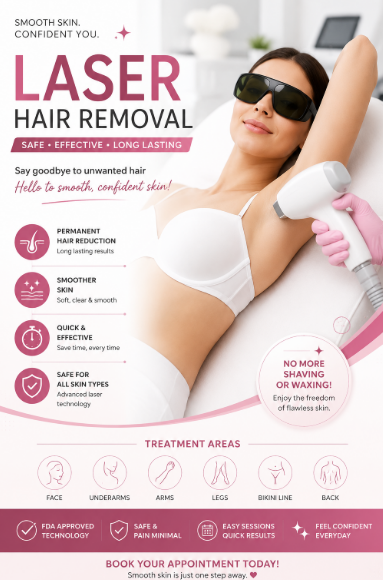
Everyone in the treatment room should use appropriate protective eyewear. The clinician places the device against or near the skin and delivers controlled pulses over the agreed area. Patients may experience warmth, stinging or a sensation sometimes compared with a small snap against the skin. Cooling may be used to protect the surface and improve comfort.
Treatment time depends on the area. A small facial area may take a few minutes, while legs, back or other large areas take longer. The AAD notes that a small area such as the upper lip can be treated quickly, whereas large areas may take more than an hour.
How many sessions are usually needed?
Most people need a course of treatments because only some hairs are in the responsive growth phase during each session. The exact number and interval vary by body area, hair density, skin tone, device, settings and hormonal influence.
The AAD states that many patients require two to six treatments, while its overview notes that six or more may be needed in some cases. Treatment is often repeated at intervals decided by the dermatologist, and maintenance sessions may be appropriate when hair regrows.
A responsible provider should not promise a fixed session count before assessing the patient.
Can laser hair removal be permanent?
Laser treatment can produce long-lasting or stable hair reduction, but it should not be presented as a guarantee that every treated hair will disappear forever.
Some patients remain hair-free in treated areas for months or years. When hair returns, it may be finer, lighter or less dense. Facial hair influenced by hormones may be more likely to return, and maintenance treatment may be needed.
Potential benefits
For a suitable patient, laser hair removal may:
- Reduce the amount and density of unwanted hair
- Reduce the frequency of shaving or waxing
- Make regrowing hairs less noticeable
- Help some people who experience razor bumps or recurring ingrown hairs
- Treat larger areas more efficiently than follicle-by-follicle electrolysis
- Provide longer-lasting reduction than temporary hair-removal methods
The NHS notes that shaving, waxing, plucking and threading can contribute to ingrown hairs and identifies laser treatment as a longer-term hair-removal option.
Important limitations
Laser hair removal may be less effective when:
- Hair is white, grey, red, very light blond or extremely fine
- There is little contrast between the hair and surrounding skin
- Hair growth is strongly hormone-driven
- Treatment settings are too conservative to create an effect
- Sessions are not completed at clinically appropriate intervals
- The patient continues plucking or waxing against instructions
- The device is not appropriate for the patient’s skin tone
- Expectations involve complete, permanent removal of every hair
A lower price does not establish that the technology, operator or treatment plan is appropriate.
Risks and possible side effects
Temporary redness, swelling and discomfort are common. These effects often resemble mild sunburn and generally improve within a few days.
Less common complications include:
- Blistering
- Burns
- Crusting
- Infection
- Scarring
- Cold-sore or herpes reactivation
- Temporary skin darkening
- Temporary skin lightening
- Rarely, persistent pigment change
- An unsatisfactory or uneven response
The AAD warns that burns, scars and permanent skin-colour changes can occur when laser treatment is used by an inexperienced operator. Risk may be reduced through qualified clinical oversight, suitable technology, conservative settings where appropriate, sun avoidance and proper aftercare.
People with darker skin tones can receive laser hair removal, but device selection, wavelength, pulse duration, cooling and operator experience are particularly important. North Bristol NHS Trust notes a greater pigment-change risk in darker or recently tanned skin.
Can laser hair removal cause cancer?
Laser hair removal uses non-ionising light rather than the ionising radiation used in X-rays or nuclear procedures. Cancer Council Australia states that current evidence does not show that laser hair removal causes cancer, although long-term effects have not been studied completely. It advises additional caution for people with atypical moles or a personal or family history of skin cancer.
Do not treat directly over an unexplained, changing or suspicious mole without clinical evaluation.
Laser hair removal versus electrolysis
| Factor | Laser hair removal | Electrolysis |
|---|---|---|
| Method | Light targets pigment in multiple hairs over an area | A fine probe treats one follicle at a time |
| Best suited to | Larger areas and sufficiently pigmented hair | Small areas or hairs poorly suited to laser |
| Hair colour | Less predictable for white, grey or very light hair | Can treat hair regardless of pigment |
| Speed | Faster for larger areas | Slower because follicles are treated individually |
| Expected outcome | Long-term or permanent reduction | Can provide permanent removal of treated follicles |
| Sessions | Several sessions plus possible maintenance | Repeated sessions over a longer period |
| Main considerations | Skin tone, device, settings and operator experience | Time, discomfort and practitioner skill |
The right option depends on hair colour, skin tone, treatment area, budget, time and expectations. Some patients may use laser to reduce dense hair and electrolysis for lighter or isolated remaining hairs.
Alternatives to laser treatment
Alternatives include:
- Shaving
- Trimming
- Threading
- Waxing
- Sugaring
- Depilatory creams
- Mechanical epilation
- Electrolysis
- Medical assessment and treatment of an underlying hormonal condition
Temporary methods remain reasonable when the patient does not want a procedure, has hair unlikely to respond to laser or is not currently suitable for treatment.
How should you prepare?
Follow the treating clinician’s instructions. General preparation commonly includes:
- Avoid tanning and deliberate sun exposure
- Use broad-spectrum sun protection
- Do not use a tanning bed or sunless tanning product
- Disclose all medicines and recent treatments
- Tell the doctor about cold sores, abnormal scarring and previous laser reactions
- Avoid waxing, threading or plucking for the instructed period
- Shave only when and how the clinic advises
- Arrive without products that the clinic asks you to remove
- Report any new rash, infection, cut or sunburn before treatment
The AAD recommends daily broad-spectrum, water-resistant SPF 30+ sunscreen and avoiding tanning before laser hair removal.
What should you expect afterward?
Redness and mild swelling can occur immediately. Many people return to routine activities, but the treated skin should be protected from sun exposure and irritating products according to the clinic’s instructions.
Aftercare may include:
- Cool compresses when recommended
- Gentle cleansing
- Avoiding scratching, rubbing and picking
- Using recommended moisturiser
- Avoiding direct sun
- Applying suitable sunscreen
- Avoiding heat, vigorous exercise or fragranced products for the period advised
- Allowing treated hairs to shed naturally
- Contacting the clinic when symptoms are more severe than expected
When should urgent medical help be sought?
Contact the treating clinic promptly for unexpected blistering, persistent pain, spreading redness, pus, worsening swelling, a widespread rash or significant pigment change.
Seek urgent medical care for:
- Eye pain or vision change after possible eye exposure
- Severe facial or airway swelling
- Extensive burns
- Fever with rapidly worsening skin symptoms
- Signs of a serious allergic reaction
Laser hair removal is elective and should not replace evaluation of an active infection, changing mole or unexplained skin lesion.
What affects laser hair removal cost in Nepal?
The clinic’s current price could not be verified. Cost may depend on:
- Treatment area
- Hair density
- Session duration
- Number of sessions
- Laser technology
- Whether a test patch is included
- Clinician involvement
- Cooling and consumables
- Single-session versus package pricing
- Follow-up or maintenance sessions
- Taxes and package-expiry conditions
Before paying, request a written estimate that states what is included, what is excluded and how long a package remains valid.
Why consult Dr. Parash Shrestha?
Dr. Parash Shrestha is officially listed by B&B Hospital as a Consultant Dermatologist and Venereologist with MBBS, MD and FAM qualifications and NMC No. 7527. His website lists clinical dermatology, cosmetic dermatology and laser procedures, including hair removal.
The supplied location points to Nava Derma Skin Laser Aesthetics in New Baneshwor, Kathmandu. Confirm that the required laser procedure and technology are currently available at this location when booking.
Questions to ask before starting treatment
- Which laser or light-based device will be used?
- Is it a true laser or an IPL device?
- Why is it appropriate for my skin tone and hair colour?
- Who will operate it?
- Will the dermatologist assess me before treatment?
- Is a patch test recommended?
- What result is realistic for my treatment area?
- How many sessions might I need?
- What are my specific pigment-change or scarring risks?
- What happens if I develop a burn or reaction?
- What is included in the price?
- Are maintenance sessions charged separately?
- What is the package-expiry or cancellation policy?
- Could my hair growth indicate a hormonal condition?
Book a laser hair removal consultation in Kathmandu
To discuss unwanted facial or body hair, treatment suitability, expected results, risks and cost factors, request an assessment with Dr. Parash Shrestha.
Nava Derma, New Baneshwor, Kathmandu
Phone: +977-9851145556
Confirm the current OPD schedule, treatment location, device and fee before travelling.
FAQs
Can laser hair removal cause cancer?
Current evidence does not show that laser hair removal causes cancer. Hair-removal lasers use non-ionising light, which differs from ionising radiation such as X-rays. Patients with suspicious or changing moles, or a personal or family history of skin cancer, should discuss treatment with a dermatologist before proceeding.
Can laser hair removal be permanent?
Laser hair removal can provide long-lasting or stable hair reduction, but complete lifelong removal of every hair cannot be guaranteed. Hair may remain absent for months or years and may return finer or less densely. Hormonal facial hair may be more likely to need maintenance treatment.
Can laser hair removal cause ingrown hairs?
Laser treatment is more commonly used to reduce recurrent ingrown hairs because it decreases the amount of hair growing through the skin. Temporary bumps or follicle irritation can still occur. Persistent, painful or pus-filled bumps should be assessed for folliculitis or infection.
Which permanent hair-removal option is best?
There is no single best method for everyone. Laser treatment is generally faster for larger areas with sufficiently pigmented hair and provides long-term reduction. Electrolysis treats individual follicles and may be more suitable for white, grey, very light or isolated hairs. The choice depends on skin tone, hair colour, treatment area, time, cost and expectations.
Which laser hair removal is permanent?
No laser should be presented as guaranteeing permanent removal of every hair. Appropriate laser systems may provide permanent hair reduction, meaning a stable long-term decrease in regrowing hair. Results depend on the device, settings, skin tone, hair characteristics, body area and hormonal influences.
When should laser hair removal be used?
Laser hair removal may be considered when unwanted hair, repeated shaving, razor bumps or ingrown hairs are bothersome and the hair is likely to respond to laser energy. Sudden or rapidly increasing hair growth should first be medically evaluated because a hormonal or medicine-related cause may need attention.
Is laser hair removal safe?
Laser hair removal is generally safe when the patient is properly assessed, an appropriate device is selected and treatment is performed by a trained professional. Temporary redness and swelling are common. Burns, blistering, infection, scarring and skin-colour changes are possible, especially with unsuitable settings or inexperienced operation.
Can laser hair removal be done on private areas?
Selected external areas, including the bikini line, may be treated in suitable patients. Treatment boundaries, privacy, consent, skin condition and device suitability should be discussed beforehand. Internal genital or mucosal surfaces should not be assumed suitable, and active irritation, sores, infection or unexplained bumps should be assessed before cosmetic treatment.
How much does permanent laser hair removal cost in Nepal?
Laser hair removal cost in Nepal varies by body area, hair density, session duration, technology, number of sessions and package terms. Contact the clinic for a current written estimate and confirm what is included, whether tax is included, how long the package remains valid and whether maintenance sessions are charged separately.
How many laser hair removal sessions will I need?
Most patients need several sessions because hair follicles are not all in the same growth phase at one time. The number and spacing of sessions vary according to hair colour, thickness, treatment area, skin tone, hormonal influences, technology and individual response. A clinician should estimate the treatment course after assessment.
Does laser hair removal hurt?
Patients may feel warmth, stinging, warm pinpricks or a brief snapping sensation. Comfort varies by treatment area, device, settings and individual sensitivity. Cooling may help, but laser hair removal should not be advertised as completely painless for every patient.
Is laser hair removal suitable for darker skin?
Laser hair removal may be suitable for darker skin, but the technology, wavelength, settings, cooling and operator experience must be appropriate. Darker or recently tanned skin can have a higher risk of burns and pigment changes, so dermatologist assessment is important before treatment.