
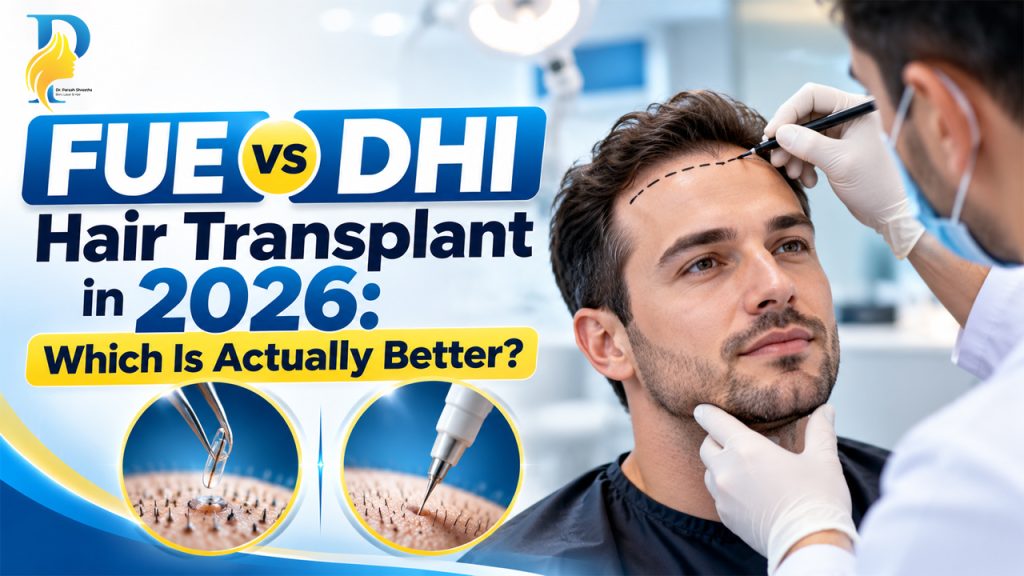
If you are comparing FUE vs DHI hair transplant, the most important thing to understand is that the names do not describe two completely separate operations.
FUE primarily describes how follicular-unit grafts are harvested from the donor area. DHI generally describes a way of implanting those grafts using an implanter device. A procedure marketed as DHI can therefore still involve FUE harvesting.
That distinction matters because it changes the question from “Which technology is better?” to something more useful:
Which harvesting and implantation approach is appropriate for my hair-loss pattern, donor supply, existing hair and long-term treatment plan?
The International Society of Hair Restoration Surgery describes FUE as one of the established donor-harvesting approaches and explains that implanters are among the tools that can be used to place harvested grafts. It specifically notes that “DHI” is terminology used by some practitioners for implantation with a sharp implanter and is not a separate hair-transplant method.
That means neither label is automatically superior.
FUE vs DHI at a glance
| Question | FUE | DHI-style implantation |
|---|---|---|
| What does the term mainly describe? | Harvesting individual follicular units | Implanting harvested grafts |
| How are grafts obtained? | Individual follicular units are excised with small punches | Often by FUE harvesting |
| How are grafts implanted? | They may be placed into pre-created recipient sites using forceps or implanters | Typically loaded into an implanter that creates/uses a recipient opening and places the graft |
| Does it avoid all scars? | No | No, if the donor follicles were harvested with FUE, FUE donor scars still occur |
| Is it automatically more successful? | No universal guarantee | No universal guarantee |
| Which is better? | Depends on the complete surgical plan | Depends on the complete surgical plan |
The key point is that FUE and DHI are not truly opposite categories.
What is FUE hair transplantation?
FUE is short for Follicular Unit Excision. “Follicular Unit Extraction” remains common wording among patients and clinics, but ISHRS adopted “excision” because the procedure involves making a small incision around each follicular unit before removing it.
During FUE harvesting, naturally occurring groups of hair follicles are individually removed from a suitable donor area, commonly the back or sides of the scalp.
The harvested grafts are then prepared and transferred to recipient areas affected by permanent hair loss.
Importantly, FUE describes the donor-harvesting stage. It does not require only one particular implantation technique.
After harvesting, grafts may be placed into pre-made recipient sites with forceps, with a “stick-and-place” approach, or with an implanter device.
This is one reason advertisements that present FUE and DHI as entirely separate biological procedures can be confusing.
For a broader explanation of transplantation, candidacy and recovery, see the hair transplant in Nepal guide.
What does DHI mean?
DHI usually stands for Direct Hair Implantation.
In commonly marketed DHI workflows, harvested grafts are loaded into a pen-like implanter. A sharp implanter can create the recipient opening and insert the graft in one movement. Dull implanters can also be used to place grafts into sites that have already been created.
Implanter technology is not new. Medical literature describes the Choi implanter, introduced in the early 1990s, as one of several techniques developed for follicular-unit placement. A 2023 review of graft-placement techniques concluded that selection of the implantation technique depends on the advantages, disadvantages and adaptation of the surgical team rather than identifying one device as universally superior.
ISHRS goes further in clarifying terminology: DHI is not a separate donor-harvesting method and should not be marketed as though it were an entirely distinct form of transplantation.
So a procedure described as “DHI” may effectively involve:
FUE harvesting + implanter-based graft placement.
Is DHI more successful than FUE?
There is no good basis for promising that DHI automatically produces a higher success rate than a properly planned FUE-based procedure using another established placement method.
The scientific literature supports hair transplantation as an established treatment for appropriately selected patients, but outcomes depend on multiple variables: patient selection, donor quality, graft harvesting, graft handling, recipient-site design, implantation, postoperative care and progression of the patient’s underlying hair loss.
Implanters can have technical advantages. ISHRS notes that an implanter can potentially reduce direct handling of the follicular bulb compared with forceps.
However, a plausible technical advantage should not be converted into an unsupported promise such as “DHI guarantees better graft survival.”
The condition of the grafts, operator technique, time outside the body, recipient-site planning and overall surgical workflow all matter.
Does DHI produce greater density?
Not automatically.
Visual density after transplantation depends on factors including:
- the number and quality of available donor grafts
- hair calibre and curl
- scalp-to-hair colour contrast
- the size of the area being restored
- follicular-unit composition
- hairline design
- angle and direction of placement
- existing native hair and
- long-term progression of hair loss.
A patient with limited donor supply cannot safely overcome that limitation simply by choosing an implanter.
Aggressive attempts to maximise graft numbers or density can also create problems. A recent review of FUE complications identified donor depletion, scarring, folliculitis, recipient-site complications and unnatural results among recognised concerns.
The better question is therefore not “Which method can pack in the most grafts?”
It is:
How can the available donor hair be used safely and strategically to create a natural result that remains appropriate as hair loss progresses?
FUE vs DHI scarring: is either method scarless?
Neither should be advertised as truly scarless.
With FUE harvesting, each harvested follicular unit requires a small incision. These usually heal as tiny scattered marks rather than the linear donor scar associated with strip harvesting, but scars still form.
ISHRS specifically warns consumers that claims of “scarless” hair-transplant surgery are misleading.
If a so-called DHI procedure uses FUE to harvest the grafts, the donor area still undergoes FUE harvesting and therefore has the same fundamental issue of many small extraction/excision sites.
Recipient-site healing may differ according to the instruments and technique used, but it would be inappropriate to promise that choosing DHI means “no cuts” or “no scars.”
Which has faster recovery?
There is not enough justification for giving every patient a fixed FUE-versus-DHI recovery winner.
If both procedures use FUE harvesting, their donor-area recovery can be broadly similar because the follicles were obtained by the same general donor method.
Recipient-area healing may differ with instrument size, number and distribution of sites, surgical technique, graft count and individual healing.
Redness, crusting, swelling or temporary discomfort can occur after hair transplantation. Early shedding of transplanted hairs is also expected in many patients.
The American Academy of Dermatology notes that transplanted hairs commonly shed during the early postoperative period and that visible results generally develop over several months, with some patients requiring up to a year to see their result.
That timeline is more useful than promises that one branded technique will make the transplant “heal instantly.”
What matters more than FUE vs DHI?
Several factors are likely to matter more to your final outcome than the marketing label attached to the procedure.
Correct diagnosis
Not every person losing hair needs transplantation.
Pattern hair loss, telogen effluvium, inflammatory scalp disease, alopecia areata and scarring alopecia are different problems. Transplanting someone before understanding the cause of hair loss can lead to inappropriate surgery.
If you are experiencing unexplained shedding or rapidly changing density, review the causes of hair thinning before assuming surgery is the next step.
Donor-area assessment
A hair transplant redistributes existing follicles. It does not generate an unlimited new supply.
Your donor area therefore functions like a finite biological resource. Overharvesting can produce visible donor depletion or patchiness.
Hairline design
A technically successful transplant can still look unnatural if the hairline is placed too low, too straight or without appropriate direction and irregularity.
Long-term design should account for the possibility that surrounding native hair can continue thinning.
Graft handling
Follicular units are delicate. Harvesting trauma, drying, excessive handling and poor placement can affect graft quality.
The choice of forceps, implanter or another placement workflow is therefore only one part of graft protection.
Who performs the surgical steps
This is particularly important.
The ISHRS position statement says preoperative diagnosis, surgical planning, donor harvesting, hairline design, recipient-site creation and management of medical issues are physician-level responsibilities, subject to local laws governing appropriately licensed professionals.
Patients should ask exactly who will perform each stage rather than assuming the doctor’s name on an advertisement means the doctor performs the procedure.
When might an implanter-based approach be considered?
Implanters can be useful surgical tools in appropriate cases. They may allow the graft to be inserted without directly grasping the bulb and can combine recipient-site creation and placement when a sharp implanter is used.
Whether that is desirable depends on factors such as the recipient area, surrounding native hair, graft characteristics, the planned density and the surgeon’s experience with the device.
It is therefore reasonable for a clinician to prefer an implanter in some areas or cases and another placement approach in others.
What is not reasonable is assuming that the word “DHI” itself guarantees greater density, faster healing or better survival.
When might a conventional FUE workflow be appropriate?
FUE harvesting remains one of the established modern ways of obtaining donor grafts. A 2025 review described FUE and linear strip excision as state-of-the-art methods used in contemporary transplantation.
After FUE harvesting, recipient sites may be created according to the surgical plan and grafts placed using forceps or implantation devices.
This workflow offers considerable flexibility because harvesting and implantation decisions do not have to be treated as one branded package.
The most appropriate plan depends on the individual patient.
Are FUE and DHI permanent?
Transplanted follicles taken from suitable donor areas can continue producing hair after successful transplantation, but that does not mean the patient’s overall hair density is permanently fixed.
Native, non-transplanted follicles may continue to thin because transplantation does not automatically stop androgenetic alopecia.
The American Academy of Dermatology notes that medical treatment may be recommended after transplantation to help slow continuing hair loss and maintain the surrounding native hair.
This is another reason long-term planning matters more than choosing the newest-sounding technique.
What are the risks?
Hair transplantation is surgery.
Potential problems include pain, swelling, bleeding, folliculitis, infection, scarring, temporary shedding, donor depletion, unsatisfactory density, an unnatural hairline and graft loss. Serious complications are uncommon, but they are not impossible.
Risk depends on the patient, technique, clinical environment and people performing the procedure.
Seek individualized medical evaluation if you have active scalp disease, unusual hair loss, major medical conditions, healing problems or medications that could affect surgery.
FUE vs DHI cost in Nepal
There is no medically meaningful universal price difference that applies to every clinic.
Hair-transplant cost can depend on graft requirements, donor characteristics, treatment area, surgical complexity, facility, staff involvement, investigations, medicines and follow-up.
Some clinics charge different prices for branded techniques, but a higher price does not by itself prove a better clinical outcome.
For current Nepal pricing context, see the 2026 hair transplant cost guide.
When comparing quotations, ask what the price actually includes and who performs the important surgical steps.
Choosing between FUE and DHI in Kathmandu
If you are researching a hair transplant in Kathmandu, do not begin by asking a clinic only:
“Do you offer FUE or DHI?”
Ask instead:
- What type of hair loss do I have?
- Is my hair loss stable enough for transplantation?
- How healthy is my donor area?
- How will the grafts be harvested?
- How will the recipient sites be created?
- How will the grafts be implanted?
- Who will perform each surgical step?
- Why is this workflow appropriate for my particular case?
- What scarring should I realistically expect?
- What happens if my natural hair continues thinning?
- What complications should I understand?
- What is included in the quotation?
Those answers are far more informative than the acronym printed on a clinic advertisement.
Does Dr Parash Shrestha perform FUE or DHI?
Yes. Dr Parash Shrestha performs FUE hair transplantation and provides dermatologist-led assessment and treatment planning for patients considering hair restoration. His approach focuses on selecting the appropriate harvesting and implantation technique based on the patient’s hair-loss pattern, donor-area quality, required coverage and long-term treatment goals.
Dr Shrestha is a Consultant Dermatologist & Venereologist with MBBS, MD and FAM qualifications and Nepal Medical Council registration No. 7527. His professional credentials are independently listed by B&B Hospital, and Nava Derma in New Baneshwor also lists him among its clinical team.
Patients interested specifically in DHI or implanter-based hair transplantation can discuss the available implantation technique during consultation, as the most suitable approach should be determined after evaluating the scalp, donor area and expected outcome.
Rather than choosing a hair transplant based only on the terms FUE or DHI, the more important step is to have your hair-loss pattern and donor suitability professionally assessed so that an appropriate treatment plan can be recommended.
Frequently asked questions
Is DHI better than FUE?
Not universally. The terms describe different parts of the transplantation process: FUE describes donor harvesting, while DHI generally describes implanter-based placement. The better surgical plan depends on the individual case and the team performing it.
Does DHI use FUE extraction?
Frequently, yes. Many procedures advertised as DHI use FUE to harvest the follicular units and an implanter for placement.
Is DHI scarless?
No hair-transplant surgery should be promised as scarless. If FUE harvesting is used, numerous small donor incisions are created and small scars can remain.
Does DHI guarantee better graft survival?
No reliable universal guarantee can be made simply because an implanter is used. Graft survival depends on harvesting, handling, storage, implantation technique and patient-related factors.
Which technique is better for a natural hairline?
Naturalness depends heavily on hairline design, selection of appropriate grafts, direction, angle, distribution and long-term planning. Either forceps- or implanter-based placement can be used successfully by appropriately trained teams.
Final takeaway
The most accurate answer to FUE vs DHI hair transplant: which is better? is that the comparison itself is often oversimplified.
FUE primarily describes how grafts are harvested.
DHI generally describes how grafts are implanted.
They can therefore be used within the same procedure.
The technique name matters less than correct diagnosis, responsible donor management, graft handling, natural hairline planning, qualified surgical involvement and a realistic strategy for future hair loss.
If you are considering a hair transplant in Kathmandu, an assessment can determine whether transplantation is appropriate and which harvesting and implantation workflow makes sense for your scalp rather than choosing a procedure from its marketing name.