
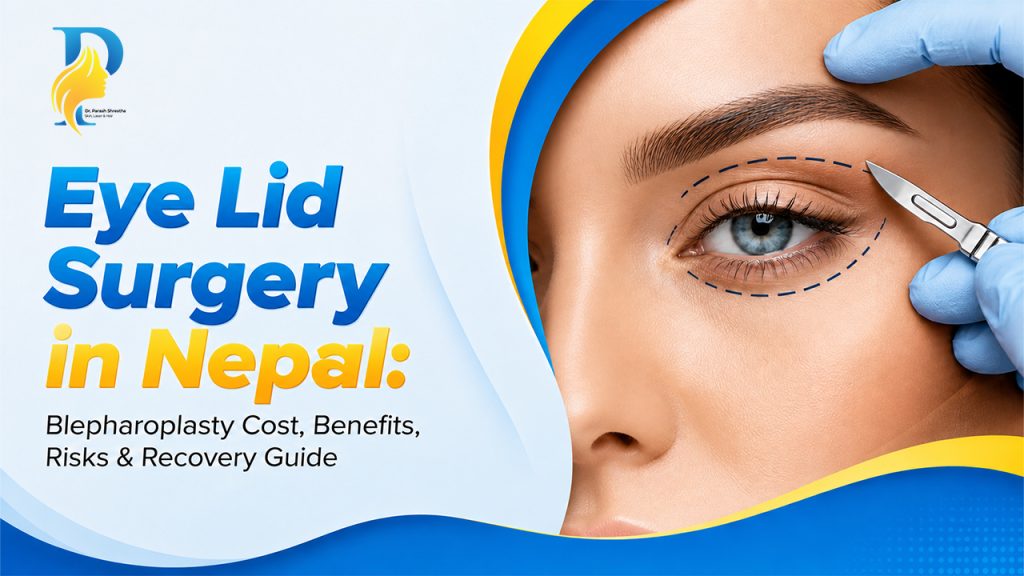
Eye lid surgery in Nepal, also called blepharoplasty, is a surgical procedure that removes or adjusts excess eyelid skin, fat, and sometimes muscle to improve the appearance or function of the upper or lower eyelids. It may help people with heavy eyelids, under-eye bags, droopy-looking eyes, or eyelid skin that affects vision.
This guide explains blepharoplasty, expected recovery, possible risks, cost factors, and how to decide whether eyelid surgery is suitable for you.
Dr. Parash Shrestha is a licensed dermatologist in Nepal with NMC No. 7527, MBBS, MD, and FAM qualifications, and experience in clinical dermatology, cosmetic dermatology, laser procedures, and hair restoration.
What Is Blepharoplasty?
Blepharoplasty is eyelid surgery performed to improve the upper eyelids, lower eyelids, or both. According to the American Society of Plastic Surgeons, eyelid surgery can address loose upper eyelid skin, puffiness caused by fat deposits, under-eye bags, drooping lower eyelids, and excess lower eyelid skin or wrinkles.
In simple terms, the procedure is designed to make the eyelid area look less heavy or tired while preserving a natural eye shape.
Blepharoplasty may be done for two main reasons:
| Purpose | What It Means |
| Cosmetic | To improve tired-looking, puffy, or aged eyelids |
| Functional | To reduce excess upper eyelid skin that may interfere with vision |
Not every person with tired-looking eyes needs surgery. Sometimes pigmentation, eye hollowness, allergies, fluid retention, sleep issues, or skin laxity may create a similar appearance.
That is why a proper consultation is important before deciding on eyelid correction surgery.
Why Do People Search for Eye Lid Surgery in Nepal?
People commonly search for eyelid surgery in Nepal when they notice:
- Heavy upper eyelids
- Hooded eyelids
- Excess skin folding over the eyelid crease
- Puffy eyelids
- Under-eye bags
- Asymmetry between both eyes
- Tired or aged facial expression
- Difficulty applying eye makeup
- Reduced upper visual field due to loose eyelid skin
Blepharoplasty is also becoming more discussed globally. ISAPS reported that eyelid surgery became the most common surgical aesthetic procedure worldwide in 2024, with more than 2.1 million procedures and a 13.4% increase from the previous year.
This does not mean everyone should get surgery. It means more people are actively learning about the procedure and comparing safe, natural-looking options.
Types of Blepharoplasty
Upper Eyelid Surgery
Upper blepharoplasty focuses on loose or sagging skin on the upper eyelids.
It may be suitable when excess skin creates a hooded appearance or makes the eyes look tired. In some people, heavy upper eyelid skin can also affect peripheral vision.
During the procedure, the incision is usually placed along the natural upper eyelid crease so the scar can be less noticeable after healing.
Lower Eyelid Surgery
Lower blepharoplasty is done for under-eye bags, puffiness, loose lower eyelid skin, or fat bulging.
Depending on the case, the surgeon may remove or reposition fat and tighten skin. In selected cases, the incision may be made inside the lower eyelid.
Lower eyelid surgery is generally more technically sensitive than upper eyelid surgery because the lower eyelid must maintain proper support and shape.
Double Eyelid Surgery
Some patients ask about double eyelid surgery or Asian blepharoplasty. This procedure creates or defines an upper eyelid crease.
The goal should be natural balance, not changing a person’s ethnic identity. Good planning considers facial structure, eyelid anatomy, symmetry, and patient preference.
Combined Upper and Lower Blepharoplasty
Some people need both upper and lower eyelid correction. This may be considered when there is both upper eyelid heaviness and lower eyelid puffiness.
Combined surgery may involve longer procedure time, more swelling, and a different cost structure.
Who Is a Good Candidate for Blepharoplasty?
A good candidate is usually someone who has realistic expectations, is medically fit for surgery, and has a specific eyelid concern that surgery can improve.
You may be a suitable candidate if you have:
- Loose upper eyelid skin
- Under-eye bags caused by fat bulging
- Eyelid puffiness that does not improve with skincare
- Healthy eyes without uncontrolled dryness
- Stable medical conditions
- No active eye infection
- Realistic expectations about results
You may need extra evaluation if you have dry eyes, thyroid eye disease, glaucoma, diabetes, high blood pressure, bleeding disorders, or take blood-thinning medicines.
Mayo Clinic notes that before blepharoplasty, patients may meet a plastic surgeon, ophthalmologist, or oculoplastic surgeon, especially when eye function is involved.
Who Should Avoid or Delay Eyelid Surgery?
Blepharoplasty may not be the right first step if your concern is mainly caused by:
- Dark circles from pigmentation
- Tear trough hollowness
- Active allergies
- Poor sleep
- Facial swelling
- Uncontrolled dry eyes
- Unrealistic expectations
- Pressure from others to change your appearance
For younger patients, especially teenagers, cosmetic eyelid surgery should be approached very carefully. Surgery is usually best considered after physical and emotional maturity, unless there is a clear medical or functional reason and proper guardian involvement.
Blepharoplasty Cost in Nepal
The blepharoplasty cost in Nepal varies depending on the type of eyelid surgery, clinic setup, surgeon experience, anesthesia, complexity, and whether upper, lower, or both eyelids are treated.
Nepal clinic prices commonly range from around NPR 35,000 to NPR 72,000 or more for selected eyelid procedures. Some eyelid surgery costs around NPR 35,000–50,000, others around NPR 35,000–60,000, and some list upper eyelid or eye bag surgery around NPR 72,000.
These figures are general market references, not a fixed quotation.
Estimated Cost Table
| Procedure Type | General Cost Consideration |
| Upper eyelid surgery | Usually less complex than combined surgery |
| Lower eyelid surgery | May cost more due to technical complexity |
| Upper + lower blepharoplasty | Higher total cost than one area |
| Revision eyelid surgery | Often more complex and may cost more |
| Functional eyelid correction | May require additional eye evaluation |
What Affects the Cost of Eyelid Surgery in Nepal?
The cost of eyelid surgery in Nepal can depend on:
- Surgeon’s qualification and experience
- Upper eyelid vs lower eyelid procedure
- One eyelid, both eyelids, or four-lid surgery
- Local anesthesia vs sedation or general anesthesia
- Hospital or clinic facility charges
- Lab tests or eye evaluation
- Medications and follow-up visits
- Revision complexity
- Whether another procedure is combined
For accurate pricing, an in-person examination is usually needed. Photos alone may not show eyelid laxity, eye closure, tear film quality, or brow position properly.
What Happens During the Consultation?
A good consultation for blepharoplasty in Nepal should not feel rushed.
The doctor should assess your eyelid skin, fat pads, brow position, facial symmetry, eye closure, tear symptoms, and medical history.
You may be asked about:
- Dry eyes or irritation
- Contact lens use
- Previous eye surgery
- Thyroid disease
- Bleeding history
- Current medicines
- Smoking or vaping
- Expectations from surgery
The doctor may also explain whether the problem is truly eyelid-related or due to brow drooping, under-eye hollowing, pigmentation, or skin quality.
Dr. Parash Shrestha emphasizes accurate diagnosis, ethical treatment planning, and long-term skin and hair health rather than temporary cosmetic fixes.
How Is Eyelid Surgery Performed?
The exact technique depends on your eyelid anatomy and surgical plan.
For upper eyelid surgery, the incision is commonly placed in the eyelid crease. Excess skin is removed carefully. Sometimes a small amount of muscle or fat may be adjusted.
For lower eyelid surgery, the incision may be placed just below the lash line or inside the lower eyelid. Fat may be removed, repositioned, or combined with skin tightening.
The goal is not to remove as much tissue as possible. Over-removal can create an unnatural look, difficulty closing the eyes, or dryness.
A conservative and anatomy-based approach is usually safer.
Recovery After Blepharoplasty
Recovery varies by patient and procedure type.
Cleveland Clinic notes that stitches in the upper lids may remain for about a week, swelling and bruising are common, and many people feel comfortable going out in public after 10 to 14 days, although complete healing can take months.
Typical Recovery Timeline
| Time After Surgery | What Many Patients Experience |
| Day 1–3 | Swelling, bruising, tightness, mild discomfort |
| Day 4–7 | Bruising may peak then slowly improve; stitches may be removed |
| Week 2 | Many people feel comfortable returning socially |
| Week 3–4 | Makeup may be allowed if healing is good and doctor approves |
| 1–3 months | Scars soften, swelling continues to settle |
| Several months | Final result becomes clearer |
Follow-up care matters. You should follow the doctor’s instructions on wound care, medications, cold compresses, activity restrictions, and warning signs.
Is Eyelid Surgery Painful?
Most patients describe blepharoplasty as mild to moderately uncomfortable rather than severely painful.
You may feel tightness, swelling, watering, dryness, or bruising around the eyelids. Pain that is severe, worsening, one-sided, or associated with vision changes should be treated urgently.
Do not self-medicate with blood-thinning painkillers unless your doctor allows it.
Is Eyelid Surgery Risky?
Yes, eyelid surgery has risks, although serious complications are uncommon when the procedure is done for the right patient by a qualified professional.
The American Society of Plastic Surgeons lists possible risks such as anesthesia issues, bleeding, numbness, difficulty closing the eyes, dry eyes, infection, lid lag, swelling, bruising, and possible need for revision surgery.
Mayo Clinic also lists rare but important risks, including infection, bleeding, dry or irritated eyes, eyelid problems, scarring, injury to eye muscles, temporary blurred vision, and rarely loss of eyesight.
This is why eyelid surgery should never be treated like a simple beauty service. It is a medical procedure near the eyes.
How to Reduce Risk Before Blepharoplasty
You cannot remove all surgical risk, but you can reduce avoidable risk by choosing proper evaluation and care.
Important safety steps include:
- Choose a qualified doctor or surgeon
- Discuss dry eyes and eye history honestly
- Share all medications and supplements
- Stop smoking before and after surgery if advised
- Avoid unrealistic “celebrity eye” expectations
- Follow pre-operative instructions
- Attend scheduled follow-ups
- Report vision changes immediately
A careful consultation is especially important for people with thyroid disease, diabetes, high blood pressure, dry eyes, or previous eye procedures.
Blepharoplasty vs Non-Surgical Options
Not every eyelid concern requires surgery.
| Concern | Surgical Option | Non-Surgical Option |
| Excess upper eyelid skin | Upper blepharoplasty | Limited improvement with skin tightening |
| Under-eye bags from fat | Lower blepharoplasty | Fillers may camouflage selected cases |
| Fine lines | Lower eyelid skin tightening | Laser, peels, skincare |
| Dark circles | Usually not blepharoplasty alone | Pigmentation treatment, skincare, lasers |
| Brow drooping | Brow lift may be needed | Botox in selected cases |
| Mild skin laxity | May not need surgery | Energy-based treatments |
Non-surgical options may help mild concerns, but they cannot remove significant excess skin. Surgery may be more appropriate when there is true skin redundancy or fat bulging.
Will Blepharoplasty Change Your Face?
A well-planned blepharoplasty should make the eyes look fresher, not completely different.
The aim is usually to preserve natural eyelid shape while reducing heaviness or puffiness. Results that look too hollow, pulled, or overly tight may occur when too much tissue is removed or the procedure is not matched to facial anatomy.
This is why patient selection and conservative planning are important.
Do Results Last Permanently?
Blepharoplasty results can last many years, but the face continues to age.
Your long-term result may depend on skin quality, genetics, sun exposure, lifestyle, weight changes, and natural aging.
Choosing a Doctor for Blepharoplasty in Nepal
For a YMYL topic like surgery, trust and qualifications matter.
Before choosing eyelid surgery, check:
- Medical registration
- Relevant surgical or aesthetic experience
- Before-and-after examples where appropriate
- Facility safety standards
- Clear explanation of risks
- Realistic outcome discussion
- Follow-up plan
- Emergency contact process
- Whether referral to an eye specialist is needed
Dr. Parash Shrestha is listed as a Consultant Dermatologist and Venereologist with NMC No. 7527, MBBS, MD, and FAM qualifications.
Because eyelid surgery involves the eye area, patients with functional vision symptoms, significant dry eyes, or complex eyelid anatomy may need coordinated care with an oculoplastic surgeon, ophthalmologist, or plastic surgeon.
Questions to Ask Before Eyelid Surgery
Before deciding, ask your doctor:
- Am I a good candidate for blepharoplasty?
- Is my concern caused by eyelid skin, fat, brow position, or pigmentation?
- Do I need upper eyelid surgery, lower eyelid surgery, or both?
- What type of anesthesia will be used?
- Where will the incision be placed?
- What are the risks in my specific case?
- How long is recovery?
- When can I return to work or school?
- What should I do if I notice vision changes?
- What is included in the total cost?
Good doctors welcome these questions.
FAQ: Blepharoplasty and Eyelid Surgery in Nepal
How much money does a blepharoplasty cost?
In Nepal, blepharoplasty prices often range from about NPR 30,000 to NPR 70,000 or more, depending on the clinic, eyelid area, anesthesia, and complexity. A personal consultation is needed for an exact quote.
Is eyelid surgery risky?
Yes. Eyelid surgery has risks such as swelling, bruising, infection, bleeding, dry eyes, scarring, difficulty closing the eyes, asymmetry, and rarely vision problems. Serious complications are uncommon but possible.
Do people regret blepharoplasty?
Some people may regret blepharoplasty if expectations were unrealistic, too much tissue was removed, healing was poor, or complications occurred. Most regrets can be reduced through proper consultation, conservative planning, and choosing a qualified doctor.
Is eye surgery 100% safe?
No surgery is 100% safe. Even common procedures can have risks. Blepharoplasty is generally considered safe for suitable patients, but it must be performed with proper medical evaluation and follow-up.
What age is best for eyelid surgery?
Many suitable candidates are healthy adults in their 30s or older. Cleveland Clinic notes that adults over 18 can have eyelid surgery, but the best candidates are often healthy adults aged 30 and above, and many patients are over 40.
Final Thoughts
Blepharoplasty, or eyelid surgery, can help selected patients with heavy upper lids, under-eye bags, or excess eyelid skin. But it is still surgery near the eyes, so the decision should be careful, medical, and realistic.
The best results usually come from proper diagnosis, conservative planning, clear communication, and safe follow-up care.
For patients considering blepharoplasty in Nepal, a consultation with a qualified medical professional can help determine whether surgery, non-surgical treatment, or no treatment is the most appropriate choice.
Author Bio
Dr. Parash Shrestha is a Consultant Dermatologist and Venereologist in Nepal, registered with NMC No. 7527. He holds MBBS, MD, and FAM qualifications and has experience in clinical dermatology, cosmetic dermatology, laser treatments, and hair restoration.
Medical note: This article is for educational purposes only. It should not replace an in-person consultation, diagnosis, or treatment plan from a qualified medical professional.