
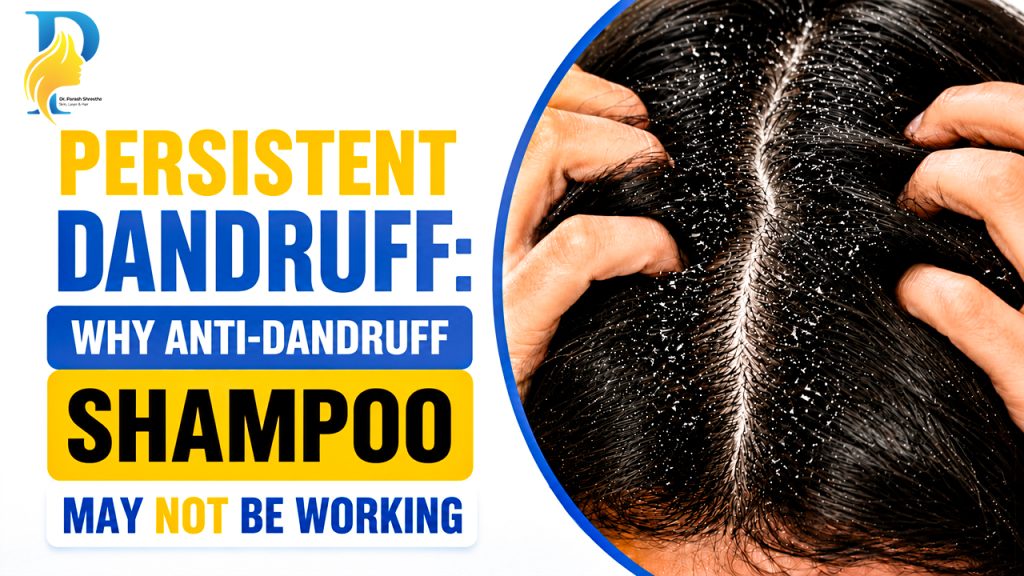
Persistent dandruff can be frustrating, especially when you are using an anti-dandruff shampoo regularly but flakes, itching, or scalp buildup keep returning. In many cases, the problem is not that your scalp is “dirty.” It may be that the shampoo’s active ingredient does not match the cause, it is not being used correctly, or the condition is not ordinary dandruff at all.
Understanding these differences is the first step toward effective dandruff treatment in Nepal and safer long-term scalp care.
Dandruff is common and usually manageable, but it can resemble seborrheic dermatitis, scalp psoriasis, eczema, contact dermatitis, or a fungal scalp infection. A persistent problem deserves a careful assessment rather than repeated product switching.
This guide explains why treatment may fail, what to look for, and when a consultation with a dermatologist or hair specialist in Nepal is appropriate.
Quick answer: Anti-dandruff shampoo may not work when the active ingredient is unsuitable, the shampoo does not stay on the scalp long enough, use is inconsistent, heavy products or an irritated scalp are worsening symptoms, or the flakes are caused by another condition. If symptoms continue after a reasonable trial, or you have redness, pain, patches of hair loss, crusting, or oozing, seek a dermatology assessment.
What Is Persistent Dandruff?
Persistent dandruff means scalp flaking that continues or repeatedly returns despite regular scalp care or a trial of anti-dandruff shampoo. It may appear as fine white flakes, greasy yellow scales, itchiness, or visible buildup on the scalp and shoulders.
Dandruff is often considered the mild, non-inflamed end of seborrheic dermatitis. It is linked with a combination of scalp oil, skin barrier sensitivity, and the normal skin yeast called Malassezia.
This does not mean dandruff is caused by poor hygiene or that it is contagious.
A useful point to remember is that scalp flaking is a symptom, not a single diagnosis. When an anti-dandruff product is not working, the key question is not simply, “Which shampoo should I try next?”
The more useful question is: “What is actually causing the itching and flaking on my scalp?”
Why Is My Dandruff Not Going Away?
There are several possible reasons why dandruff keeps coming back. In some cases, more than one factor may be involved.
1. It May Not Be Ordinary Dandruff
Not every flaky scalp is dandruff.
Seborrheic dermatitis may cause oily or yellowish scale with redness. It can also affect the eyebrows, sides of the nose, beard area, ears, or chest.
Scalp psoriasis may produce thicker and more defined scales. The flaky patches can sometimes extend beyond the hairline or occur on other areas of the body.
Eczema can make the scalp dry, very itchy, inflamed, and sensitive.
Hair dyes, fragrance, oils, serums, gels, dry shampoos, and styling products can trigger irritant or allergic contact dermatitis in some people.
Another important possibility is tinea capitis, also called scalp ringworm. It can cause scaling with broken hairs, patchy hair loss, tenderness, or inflammation. This condition usually needs medical diagnosis and oral treatment because shampoo alone cannot treat infection at the hair root.
2. The Active Ingredient May Not Match the Cause
Not all anti-dandruff shampoos work in the same way.
Some shampoos target yeast overgrowth. Others loosen the thick scale, reduce oil, or support control of scalp inflammation.
A shampoo that works for dry, fine flaking may not be enough for oily, sticky buildup or inflamed seborrheic dermatitis.
Do not choose a shampoo only based on foam, fragrance, or price. Look at its active ingredient and follow the instructions properly.
| Active Ingredient | Main Role | May Help With | Practical Point |
| Ketoconazole | Antifungal action | Oily, itchy, recurrent flakes or seborrheic dermatitis | Apply directly to the scalp and follow the required contact time |
| Selenium sulfide | Helps control yeast and scaling | Oily scalp and visible flaking | Rinse thoroughly and check label instructions for coloured hair |
| Zinc pyrithione | Helps control flaking and irritation | Mild-to-moderate dandruff | Can be useful for regular maintenance when tolerated |
| Salicylic acid | Helps loosen scale | Thick flakes and scalp buildup | May not control yeast by itself |
| Coal tar | Reduces excess skin-cell turnover | Selected scaling conditions, including some psoriasis cases | Can irritate sensitive scalps and may affect lighter or treated hair |
| Sulfur-containing products | Helps reduce scale and oil | Mild dandruff in selected users | Tolerability differs between products |
The availability of specific formulations may vary across pharmacies in Nepal. A dermatologist can recommend an appropriate option based on scalp type, hair routine, medical history, and the appearance of the flakes.
3. The Shampoo Is Being Used on Hair, Not the Scalp
Medicated shampoo must reach the scalp to work properly.
Applying it only to the hair length, rinsing it off immediately, or using it only occasionally may give limited results.
Wet your scalp thoroughly. Apply the shampoo directly to the scalp, gently work it into affected areas, and allow the contact time mentioned on the product label.
Many medicated shampoos need several minutes on the scalp before rinsing.
Do not leave a product on longer than directed in the hope of faster results. This can cause irritation and make itching worse.
Hair texture, oiliness, colouring, and styling practices affect how often a person can wash without drying the hair. There is no single scalp-care routine that suits everyone.
4. Treatment Is Inconsistent or Stopped Too Early
Dandruff often improves gradually rather than overnight.
Using a shampoo only when visible flakes appear can lead to repeated flare-ups. Many people need an initial treatment phase followed by a maintenance routine.
Once the scalp is under control, a dermatologist may advise less frequent use of a medicated shampoo to reduce recurrence.
This is not treatment failure. Dandruff and seborrheic dermatitis can be long-term, relapsing scalp conditions.
5. Hair Oils, Styling Products, or New Products Are Worsening the Scalp
Some people notice more itching or flaking after introducing a new hair oil, dye, dry shampoo, serum, spray, gel, or leave-in product.
In others, heavy product buildup makes flakes more difficult to remove.
Consider product irritation or allergy when symptoms begin after a new product, especially if there is burning, swelling, a sharply defined rash, or flaking on the forehead, ears, neck, or eyelids.
Keep a simple product diary for one week. Note every shampoo, conditioner, oil, dye, serum, and styling product used.
This can provide valuable clues during a dermatologist consultation.
6. A Chronic Inflammatory Condition May Need More Than Shampoo
When the scalp is very red, sore, thickly scaled, or intensely itchy, shampoo alone may not be enough.
A clinician may need to confirm whether the problem is seborrheic dermatitis, psoriasis, eczema, contact dermatitis, or another scalp condition.
Prescription treatment may be considered depending on the diagnosis and severity. This can include medicated shampoos, anti-inflammatory scalp preparations, antifungal treatment, or a combination plan.
Prescription medicines should only be used under professional guidance because the appropriate medicine, strength, and duration depend on the cause.
Dandruff, Seborrheic Dermatitis, Psoriasis, or Fungal Infection: How Do They Differ?
The table below is for awareness only. A dermatologist’s examination is more reliable than self-diagnosis.
| Possible Cause | Typical Clues | Why Shampoo May Fail | What a Clinician May Consider |
| Ordinary dandruff | Diffuse white flakes, mild itch, little redness | Wrong active ingredient or inconsistent use | Targeted medicated shampoo and scalp routine |
| Seborrheic dermatitis | Greasy or yellow scale, redness, itch; may affect face or ears | Inflammation and relapse may need a broader plan | Antifungal and anti-inflammatory treatment with maintenance care |
| Scalp psoriasis | Thicker and more defined scales; may extend beyond hairline | Standard dandruff shampoos may not control inflammation | Scalp, skin, and nail examination with condition-specific care |
| Eczema or contact dermatitis | Strong itch, dryness, burning, redness after product changes | Trigger remains in use or shampoo is irritating | Product review, trigger avoidance, inflammation control |
| Tinea capitis | Patchy scale, broken hairs, patchy hair loss, tenderness | Shampoo cannot reach the infected hair root | Fungal testing and oral antifungal treatment if confirmed |
How Do I Get Rid of Persistent Dandruff?
The safest approach is to treat persistent dandruff as a scalp-health issue, not only a cosmetic concern.
Step 1: Simplify Your Hair Routine
For around two weeks, reduce unnecessary scalp products.
Use a gentle regular shampoo between medicated washes if needed. Pause new oils, harsh scrubs, strongly fragranced products, and multiple home remedies while observing your scalp.
Avoid scratching with nails. Scratching can injure the scalp, increase inflammation, and make flakes more visible.
Step 2: Choose a Medicated Shampoo With a Purpose
Select a product with a recognised anti-dandruff active ingredient.
Use it on the scalp according to the label instructions. The correct frequency and contact time vary by product and scalp condition.
If there is no improvement after a reasonable trial, avoid layering multiple products at the same time. This can make it difficult to know what is helping and may increase irritation.
A dermatologist may recommend switching or alternating active ingredients depending on the type of scale, oiliness, and inflammation.
Step 3: Track Your Progress
Take a clear scalp photo before starting a routine and then once a week.
Track:
- Itching
- Flaking
- Redness
- Oiliness
- Burning or irritation
- Hair shedding or broken hairs
- Reactions after specific products
This helps turn a vague concern into useful clinical information.
Step 4: Seek Assessment When the Pattern Is Not Typical
See a dermatologist in Nepal when dandruff persists despite approximately one month of correctly used medicated shampoo, keeps returning quickly, or significantly affects your comfort.
A doctor can inspect the scalp and may use dermoscopy or take a fungal sample if another condition is suspected.
How to Remove Dandruff Quickly at Home: What Is Realistic?
There is no guaranteed overnight method that safely removes dandruff at home.
The fastest evidence based starting point is a correctly selected medicated shampoo used exactly as directed. Visible flakes may begin to reduce with consistent use, but thick scale or inflamed scalp conditions can take longer.
Be careful with viral “quick fixes.”
Lemon juice, baking soda, undiluted essential oils, vinegar, harsh salt scrubs, and repeated hot-water washing can irritate the scalp or trigger contact dermatitis.
Natural does not always mean gentle or effective.
At home, keep the routine simple:
- Use medicated shampoo as directed.
- Rinse thoroughly.
- Avoid scratching and aggressive scalp scraping.
- Keep combs, brushes, and pillowcases clean.
- Pause any product that clearly causes burning, swelling, or worsening itch.
For children, severe symptoms, patchy hair loss, or painful scalp lesions, do not rely only on home care.
What Does “Permanent” Dandruff Treatment Really Mean?
The phrase “kill dandruff permanently” can be misleading.
Dandruff is not usually a one-time infection that can be permanently eliminated. It is often a chronic, fluctuating scalp condition influenced by oil production, skin-barrier sensitivity, Malassezia, climate, stress, and individual susceptibility.
The realistic goal is reliable control:
- Fewer visible flakes
- Less itching
- Reduced scalp discomfort
- Less frequent flare ups
- A maintenance routine that suits your scalp and hair type
Some people need medicated shampoo only occasionally. Others may need longer term maintenance, especially when seborrheic dermatitis or psoriasis is involved.
Is Persistent Dandruff Related to Diet, Stress, or Liver Disease?
Stress and cold or dry weather can worsen dandruff for some people. Poor sleep and a demanding routine may also make flare-ups harder to control.
However, dandruff is not proof of poor hygiene, poor diet, or a serious internal disease.
There is no evidence that dandruff alone is a liver issue. Dandruff is generally a local scalp condition.
If you also have symptoms such as yellowing of the skin or eyes, severe fatigue, abdominal swelling, dark urine, or unexplained weight loss, seek medical evaluation separately instead of assuming they are caused by dandruff.
A balanced diet supports overall health, but restrictive diets and unproven supplements should not replace medical assessment for persistent scalp concerns.
When Should You See a Dermatologist for Persistent Dandruff?
Book an assessment if you have:
- No improvement after about one month of correct anti-dandruff shampoo use
- Severe itch, pain, redness, swelling, or burning
- Thick crusts, pus, bleeding, or oozing
- Patchy hair loss, broken hairs, or tender scalp lumps
- Flaking that spreads to the face, ears, beard, chest, or other body areas
- Symptoms in a child, particularly with hair loss or inflammation
- A possible reaction after using hair dye, oil, shampoo, or another product
- A history of psoriasis, eczema, immune suppression, or repeated fungal infections
At a consultation, a dermatologist will ask about symptoms, products, medical history, and examine affected areas. When necessary, tests such as fungal microscopy, culture, or patch testing can help clarify the cause.
Dandruff Treatment in Nepal: Why Diagnosis Matters
For persistent dandruff, a more accurate diagnosis is often more useful than a stronger shampoo.
Treatment plans differ for seborrheic dermatitis, psoriasis, eczema, contact allergy, and fungal scalp infection.
Dr. Parash Shrestha is a Consultant Dermatologist and Venereologist in Nepal with experience in hair and scalp disorders. A professional scalp evaluation can help identify why a product has not worked and support a treatment plan based on symptoms, scalp type, and long-term maintenance needs.
Frequently Asked Questions
How do I get rid of persistent dandruff?
Use a medicated shampoo with an appropriate active ingredient correctly and consistently. Simplify other scalp products and consult a dermatologist if symptoms do not improve after about a month or if you have redness, pain, hair loss, or thick scale.
Why is my dandruff not going away?
Possible reasons include the wrong active ingredient, insufficient contact time, irregular use, product irritation, or another condition such as seborrheic dermatitis, psoriasis, eczema, or tinea capitis.
How to remove dandruff quickly at home?
Start with a recognised medicated shampoo and follow the instructions exactly. There is no safe guaranteed overnight cure. Avoid harsh remedies such as lemon, baking soda, undiluted oils, or aggressive scrubbing.
Why do I have dandruff constantly?
Dandruff can be a chronic, relapsing scalp condition. Oil production, Malassezia yeast, skin-barrier sensitivity, stress, weather changes, and unsuitable hair products can contribute to recurring flares.
What kills dandruff permanently?
No treatment can promise to eliminate dandruff permanently for everyone. Most people can control it effectively with the right shampoo, trigger management, and maintenance care. Persistent symptoms need an accurate diagnosis.
Is dandruff a liver issue?
Usually, no. Dandruff alone is not considered a sign of liver disease. It is more often related to local scalp conditions such as dandruff or seborrheic dermatitis.
Medical Review
Dr. Parash Shrestha, MBBS, MD, FAM
Consultant Dermatologist & Venereologist | NMC No. 7527
Dr. Parash Shrestha has experience in clinical dermatology, hair and scalp disorders, cosmetic dermatology, and laser treatments in Nepal.
Last medically reviewed: June 2026