
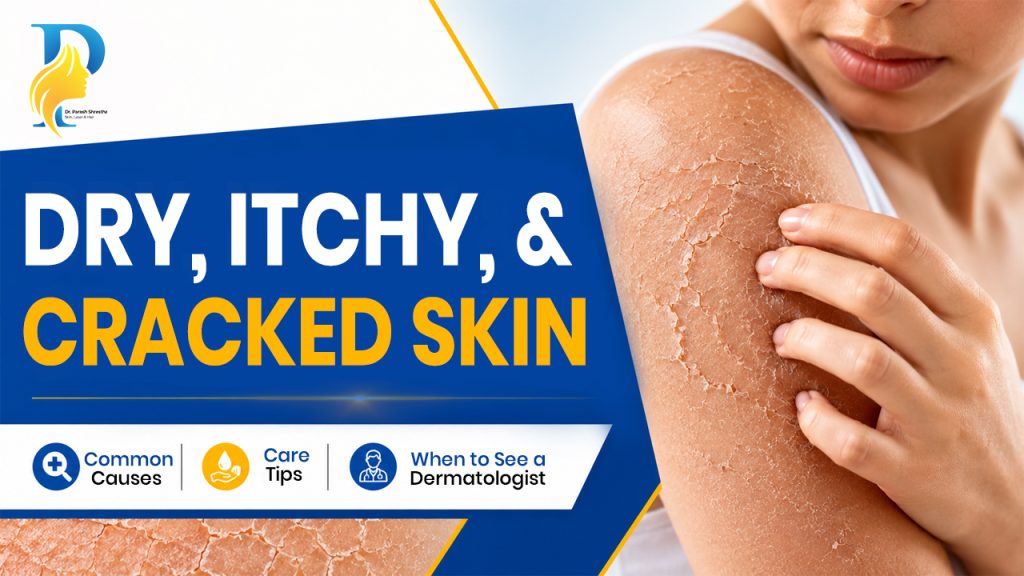
Dry, itchy, and cracked skin usually develops when the skin’s protective outer layer loses moisture and becomes less effective at keeping irritants out. Weather changes, hot showers, harsh cleansers, frequent washing, ageing and certain skin conditions can all contribute.
Regular moisturising, gentle cleansing and avoiding known triggers may improve mild dryness. However, persistent itchy skin, redness, thick scaling, painful cracks or repeated flare-ups may be caused by eczema, contact dermatitis, psoriasis, infection or another medical condition. In such cases, changing creams repeatedly may delay the correct diagnosis and treatment.
What Is Dry, Itchy, and Cracked Skin?
Dry skin, medically called xerosis, occurs when the skin does not retain enough water and protective oils.
The skin may feel tight, rough or uncomfortable. As dryness increases, the surface may begin to flake, itch or develop small cracks. In more severe cases, the cracks can become painful or bleed.
Common signs include:
- Rough or tight-feeling skin
- Fine white or grey flakes
- Itching
- Redness or irritation
- Scaling or peeling
- Fine lines that become more visible
- Painful cracks on the hands, feet or lips
- Skin that stings after applying products
The American Academy of Dermatology notes that excessively dry skin may become rough, flaky, itchy and cracked. Creams and ointments generally retain more moisture than lightweight lotions.
Dryness is common, especially among older adults. In two population based studies involving middle-aged and older adults, approximately 56% to 60% of participants had some degree of dry skin. These figures relate to the specific populations studied and should not be interpreted as the exact prevalence in Nepal.
Why Does the Skin Barrier Matter?
The outermost layer of the skin is commonly described as the skin barrier. It contains skin cells, natural fats and substances that help retain water while protecting the body from irritants, allergens and microorganisms.
When this barrier is healthy, the skin remains flexible and better able to tolerate normal environmental exposure.
When the barrier becomes damaged:
- Water escapes from the skin more easily.
- The skin becomes dry and rough.
- Irritants enter the outer layers more easily.
- Itching and inflammation may develop.
- Scratching causes further damage.
- The dryness and itching cycle continues.
This is why moisturiser is more than a cosmetic product. A suitable moisturiser can reduce water loss, soften rough skin and support recovery of the outer skin layer.
However, moisturiser alone may not control inflammation caused by eczema, allergic contact dermatitis, psoriasis or infection. The underlying condition must also be identified and treated.
What Causes Dry, Itchy, and Cracked Skin?
Dryness can result from everyday habits, environmental exposure, medical conditions or a combination of factors.
1. Cold or Low-Humidity Weather
Cold air usually contains less moisture than warm air. Indoor heating can reduce humidity further.
During dry seasons, moisture evaporates from the skin more quickly. The face, lips, hands, arms and lower legs may become especially rough or flaky.
2. Hot Showers and Long Baths
Hot water removes natural oils from the skin. Long showers also increase exposure to water and cleansers, which can weaken the outer barrier.
Shorter showers with lukewarm water are generally less drying.
3. Harsh Soap and Cleansers
Strong soaps, detergents, alcohol-based products, fragrances and heavily foaming cleansers can remove protective oils.
A product does not have to cause an immediate rash to be irritating. Repeated use may gradually lead to tightness, dryness and stinging.
4. Frequent Handwashing
Handwashing is important for hygiene, but repeated washing can make the hands dry and cracked, especially when combined with strong soap, hot water or inadequate moisturising.
Healthcare workers, cleaners, cooks, salon workers and people who frequently handle water or detergents may develop hand irritation more easily.
Applying a fragrance-free cream or ointment after washing can help reduce dryness without reducing necessary hand hygiene.
5. Ageing
The skin usually produces fewer natural oils with age. Older adults may therefore experience persistent dryness on the arms, legs, back and hands.
Age-related dryness may be made worse by medications, reduced mobility, chronic illness or frequent bathing.
6. Atopic Dermatitis or Eczema
Atopic dermatitis is a chronic inflammatory condition that commonly causes dry, itchy and inflamed skin. It may begin in childhood but can continue or first appear during adulthood.
Symptoms often come and go. Heat, sweat, stress, fragrances, detergents, dust, weather changes and skin infections can trigger flare-ups in some people.
Eczema is not contagious. It requires ongoing barrier care, trigger management and, during active inflammation, treatment prescribed according to the severity and location of the rash.
7. Contact Dermatitis
Contact dermatitis occurs when the skin reacts to something touching it.
Irritant contact dermatitis can be caused by soaps, detergents, chemicals, repeated handwashing, cement, cleaning products or prolonged water exposure.
Allergic contact dermatitis develops when the immune system reacts to a particular substance, such as fragrance, hair dye, preservatives, rubber, adhesives, metals or cosmetic ingredients.
The rash often appears where contact occurs. Identifying and avoiding the responsible trigger is a major part of treatment. Learn more in this guide to common skin allergies and their treatment.
8. Psoriasis
Psoriasis is an immune-mediated condition that may cause thick, clearly defined, scaly plaques.
It commonly affects the elbows, knees, scalp or lower back, although other areas may be involved. The skin may itch, crack or bleed.
Psoriasis is not simply severe dry skin. Moisturiser may reduce scaling and discomfort, but medical treatment is often required to control inflammation.
9. Fungal or Other Skin Infections
Some infections can look dry, red or scaly.
A fungal infection may form a ring-shaped rash, affect the feet or groin, or involve only one hand. Treating an infection as eczema—or treating eczema as an infection—may allow the problem to persist.
This is one reason a recurrent rash should be diagnosed before stronger creams are used.
10. Medical Conditions and Medicines
Persistent generalised dryness can occasionally be associated with thyroid disease, diabetes, kidney disease, nutritional problems or other medical conditions.
Some medicines and cancer treatments can also increase dryness.
This does not mean that every person with dry skin needs blood tests. Testing is generally considered when symptoms, medical history or examination findings suggest an underlying cause.
Dry Skin, Eczema, Allergy or Psoriasis: What Is the Difference?
Several conditions can produce similar symptoms. The following comparison is a general guide and not a diagnosis.
| Feature | Simple dry skin | Eczema | Contact dermatitis | Psoriasis |
|---|---|---|---|---|
| Typical appearance | Rough, flaky or tight skin | Dry, inflamed, itchy patches | Rash at or near the contact area | Thick, defined, scaly plaques |
| Itching | Mild to moderate | Often significant | Common | Variable |
| Redness or inflammation | Usually mild | Common during flares | Common | Common |
| Common pattern | Hands, legs, arms or body | Face, neck, hands and skin folds; pattern varies by age | Area exposed to an irritant or allergen | Elbows, knees, scalp and lower back |
| Common triggers | Weather, hot water, soap | Heat, sweat, irritants, allergens and stress | Soap, chemicals, fragrance, metals and occupational exposure | Immune activity, stress, infection and skin injury |
| Does moisturiser help? | Often significantly | Helpful but may not control a flare alone | Helpful after avoiding the trigger | Helps scaling but does not replace medical treatment |
| May need medical treatment? | If severe or persistent | Frequently | Frequently | Frequently |
The appearance of inflammatory skin disease can vary according to skin tone. Redness may look pink, red, purple, brown or grey rather than bright red.
Why Is My Skin Dry and Itchy?
Dryness exposes and irritates nerve endings in the outer skin, which can create itching.
Scratching may provide temporary relief, but it damages the barrier further. The damaged surface then loses more moisture and becomes more inflamed, producing more itching.
This is known as the itch–scratch cycle.
Other reasons dry skin may itch include:
- Eczema-related inflammation
- Contact with an irritating substance
- An allergic reaction
- Psoriasis
- Fungal infection
- Insect bites
- Heat or sweating
- Certain medicines
- Less commonly, an internal medical condition
Itching without a visible rash, itching affecting the entire body or severe night-time itching deserves medical assessment, particularly when it persists.
What Does a Damaged Skin Barrier Look Like?
A damaged skin barrier may cause:
- Tightness after washing
- Stinging when skincare products are applied
- Increased sensitivity to products that were previously tolerated
- Roughness or flaking
- Red or inflamed patches
- Repeated itching
- Cracks around the fingers, heels or lips
- Frequent irritation after exposure to soap, dust or weather
These symptoms do not confirm one particular diagnosis. Eczema, rosacea, contact dermatitis and inappropriate use of strong skincare products can produce overlapping signs.
How Can You Repair and Protect the Skin Barrier?
“Repairing” the barrier means reducing further damage and supporting the skin while its outer layer recovers.
1. Take Short, Lukewarm Showers
Limit prolonged bathing and avoid very hot water.
After bathing, gently pat the skin rather than rubbing it aggressively with a towel.
2. Moisturise Immediately After Washing
Apply moisturiser within a few minutes of bathing or washing, while the skin is still slightly damp.
Reapply it whenever the skin feels dry, particularly after handwashing.
The American Academy of Dermatology recommends regular application of fragrance-free cream or ointment to help relieve overly dry skin.
3. Choose Creams or Ointments for Very Dry Skin
Lotions are lighter and may be comfortable during warmer weather, but they often contain more water and may not provide enough protection for very dry skin.
Creams are thicker, while ointments form a stronger protective layer. Ointments may be especially useful for very dry hands, elbows, knees or heels.
4. Look for Barrier-Supporting Ingredients
Depending on skin type and severity, moisturisers may contain:
| Ingredient group | Examples | Main role |
| Humectants | Glycerin, hyaluronic acid, urea | Attract and hold water |
| Emollients | Ceramides, fatty acids, plant-derived oils | Smooth gaps between surface skin cells |
| Occlusives | Petrolatum, mineral oil, dimethicone | Reduce water loss from the surface |
Ceramides, glycerol, urea and lactic acid are among the ingredients dermatologists may consider for dry skin. Some active ingredients can sting when the skin is severely cracked, so product selection should reflect the condition of the skin.
5. Use a Gentle, Fragrance-Free Cleanser
Use cleanser only where it is necessary rather than repeatedly lathering the entire body.
Products labelled “fragrance-free” are generally preferable to products labelled “unscented,” which may still contain ingredients used to mask fragrance.
6. Stop Adding Multiple New Products
When the skin is irritated, using several serums, scrubs, acids, retinoids or home remedies may worsen the barrier.
A temporary simplified routine gentle cleanser, moisturiser and appropriate sun protection may help identify whether product overload is contributing.
7. Protect the Hands
Wear suitable gloves when handling detergent, cleaning chemicals or prolonged water exposure.
Cotton-lined protective gloves may be more comfortable for repeated household or occupational work.
8. Avoid Scratching
Keep nails short and use a cool compress when itching is difficult to control.
Persistent itch may require treatment of inflammation rather than more moisturiser alone.
9. Introduce New Products Carefully
Patch-testing a new skincare product on a small area for several days may help identify irritation, although it cannot reliably rule out every allergic reaction.
Stop using a product that consistently causes burning, swelling, blistering or a spreading rash.
Common Dry-Skin Mistakes
Mistake 1: Changing Moisturiser Every Few Days
Barrier recovery usually requires consistent care. Constantly changing products can make it difficult to identify which product helps or irritates the skin.
Mistake 2: Scrubbing Away Flakes
Scrubs, brushes and exfoliating acids may temporarily remove visible scales but can worsen inflammation and water loss.
Mistake 3: Using Steroid-Containing Creams Without Diagnosis
Topical corticosteroids can be appropriate for certain inflammatory conditions when the correct strength, location and duration are selected.
Unsupervised use may cause side effects, mask infection or worsen some fungal conditions.
Mistake 4: Assuming Every Itchy Rash Is an Allergy
Itching may result from eczema, psoriasis, infection, dryness, medicines or systemic disease. Allergy is only one possible explanation.
Mistake 5: Treating Only the Symptoms
Moisturiser can support the barrier, but recurrent symptoms may continue until the underlying trigger or condition is addressed.
Why Does Dry Skin Keep Coming Back?
Dryness often returns when the original cause remains present.
Common reasons include:
- Moisturiser is stopped as soon as the skin improves
- Hot showers continue
- The same irritating cleanser is still being used
- Occupational exposure continues
- An allergen has not been identified
- Eczema or psoriasis is not fully controlled
- Medication is being used incorrectly
- The diagnosis is incomplete
- Weather changes repeatedly trigger symptoms
For chronic conditions, maintenance care is often as important as treatment during a flare.
A dermatologist may help create two separate plans:
- A treatment plan for active redness, itching or scaling.
- A maintenance plan to reduce future flare-ups.
When Should You See a Dermatologist for Dry Skin?
Consider consulting a dermatologist when:
- Dryness persists despite consistent gentle skincare
- Itching interferes with sleep, work or concentration
- The rash keeps returning
- Skin is painful, bleeding or deeply cracked
- There is significant redness, swelling or warmth
- The skin develops blisters, crusting, pus or oozing
- A rash is spreading
- The condition involves the face, eyelids or genital area
- A child has persistent itching or sleep disturbance
- You are uncertain whether the problem is eczema, psoriasis, allergy or infection
- You have used several creams without lasting improvement
- The itch affects most of the body
- Symptoms began after starting a medicine
Seek prompt medical care when there is rapidly spreading redness, severe pain, fever, facial swelling, breathing difficulty or signs of a serious allergic reaction or infection.
For broader guidance, read when to visit a dermatologist in Nepal.
How Does a Dermatologist Diagnose Persistent Dry or Itchy Skin?
A dermatology consultation usually begins with a detailed history.
The dermatologist may ask:
- When the symptoms started
- Whether they come and go
- Which areas are affected
- What makes the condition better or worse
- Which soaps, cosmetics and medicines are used
- Whether family members have eczema, allergy or psoriasis
- Whether the patient has asthma or allergic rhinitis
- Whether there is workplace exposure to chemicals or water
- Which treatments have already been tried
The skin is then examined for the distribution, shape, colour, border and type of scaling.
Many skin conditions can be diagnosed clinically. In selected cases, a dermatologist may recommend:
- A fungal examination
- Patch testing for contact allergy
- Blood tests
- Skin scraping
- Dermoscopy
- Skin biopsy
Testing should be guided by the likely diagnosis rather than performed automatically.
You can also review this guide to skin health and dermatologist care in Nepal.
What Dry Skin Treatment May a Dermatologist Recommend?
Treatment depends on the diagnosis, severity, affected area, age and previous response.
A personalised plan may include:
- A suitable moisturising cream or ointment
- Replacement of harsh soaps with gentle cleansing products
- Identification and avoidance of irritants
- Prescription anti-inflammatory treatment for eczema
- Treatment for psoriasis
- Antifungal or antibacterial treatment when infection is confirmed
- Management of contact allergy
- Treatment for thick scaling or painful cracks
- Review of medicines or underlying health conditions
- A maintenance skincare plan
Different body areas require different treatment strengths. A medicine appropriate for thick skin on the hands or feet may not be appropriate for the eyelids or face.
This is why using another person’s prescription or repeatedly purchasing combination creams is not recommended.
Dermatology Care in Kathmandu and Nepal
Dryness may appear simple, but persistent scaling and itching can resemble several different skin diseases.
A qualified dermatologist can differentiate between ordinary dryness, eczema, contact dermatitis, psoriasis, fungal infection and other conditions before recommending treatment.
Dr. Parash Shrestha is an NMC-registered consultant dermatologist and venereologist with MBBS, MD and FAM qualifications. His website describes more than 15 years of experience in clinical dermatology, cosmetic dermatology, laser care and hair-related conditions. His clinical services include management of eczema, psoriasis, allergies, fungal infections and chronic skin diseases.
He consults at:
- B&B Hospital, Gwarko, Lalitpur
- Nava Derma Skin & Laser Clinic, New Baneshwor, Kathmandu
Patients may contact B&B Hospital at 01-5970999 or Nava Derma at +977-9851145556 to confirm appointment availability and consultation timing. The website currently displays consultation hours as Sunday to Friday, 10:00 AM to 5:00 PM, with Saturday closed. Confirm the schedule before travelling.
Frequently Asked Questions
What causes dry, itchy, and cracked skin?
Common causes include low humidity, hot showers, harsh soap, frequent washing, ageing and inadequate moisturising. Eczema, contact dermatitis, psoriasis, infection, certain medicines and underlying health conditions can also cause persistent symptoms.
Why is my skin dry and itchy?
Dry skin loses water and protective oils, making the surface more sensitive and likely to itch. Inflammation from eczema, allergy, psoriasis or infection can make itching more severe.
How can I repair my skin barrier?
Use lukewarm water, a gentle fragrance-free cleanser and a cream or ointment immediately after washing. Avoid scrubs, harsh active ingredients and known irritants. Persistent inflammation may need dermatologist-prescribed treatment.
Is itchy and flaky skin a sign of eczema?
It can be, but not always. Simple dryness, contact dermatitis, psoriasis and fungal infection may also cause itching and flakes. Eczema is more likely when the skin is repeatedly inflamed, intensely itchy and prone to flare-ups.
What is the difference between dry skin and eczema?
Simple dry skin mainly causes roughness, tightness and mild flaking. Eczema is an inflammatory condition that usually causes more noticeable itching, redness or colour change and recurrent patches. Both can occur together.
Why does my dry skin keep coming back?
The trigger may still be present, moisturising may have stopped too early, or an underlying condition such as eczema or contact dermatitis may not be controlled. A recurring problem needs diagnosis rather than repeated product switching.
When should I see a dermatologist for dry skin?
See a dermatologist when dryness is persistent, painful, recurrent, widespread or interfering with sleep and daily life. Consultation is also appropriate when the skin bleeds, oozes, becomes swollen or does not improve with consistent gentle care.
Final Takeaway
Dry skin may improve with regular moisturising and simple changes in bathing and cleansing habits. But dry, itchy and cracked skin is not always caused by a lack of moisturiser.
Repeated itching, inflammation, scaling or painful cracks may indicate eczema, contact dermatitis, psoriasis, infection or another condition that requires targeted care.
Instead of repeatedly changing creams, focus on protecting the skin barrier, observing possible triggers and obtaining a clear diagnosis when symptoms persist.
To discuss recurring dryness, eczema symptoms or persistent itching, contact Dr. Parash Shrestha’s dermatology practice and confirm the appropriate consultation location and schedule.
About the Author and Medical Reviewer
Dr. Parash Shrestha, MBBS, MD, FAM
Consultant Dermatologist and Venereologist
NMC Registration No. 7527
Dr. Parash Shrestha has more than 15 years of experience in clinical dermatology, cosmetic dermatology, laser procedures and hair-related treatment. His clinical work includes eczema, psoriasis, skin allergies, infections and other chronic skin conditions.
This article is intended for patient education. It does not replace an examination, diagnosis or individualised treatment plan from a qualified healthcare professional.