
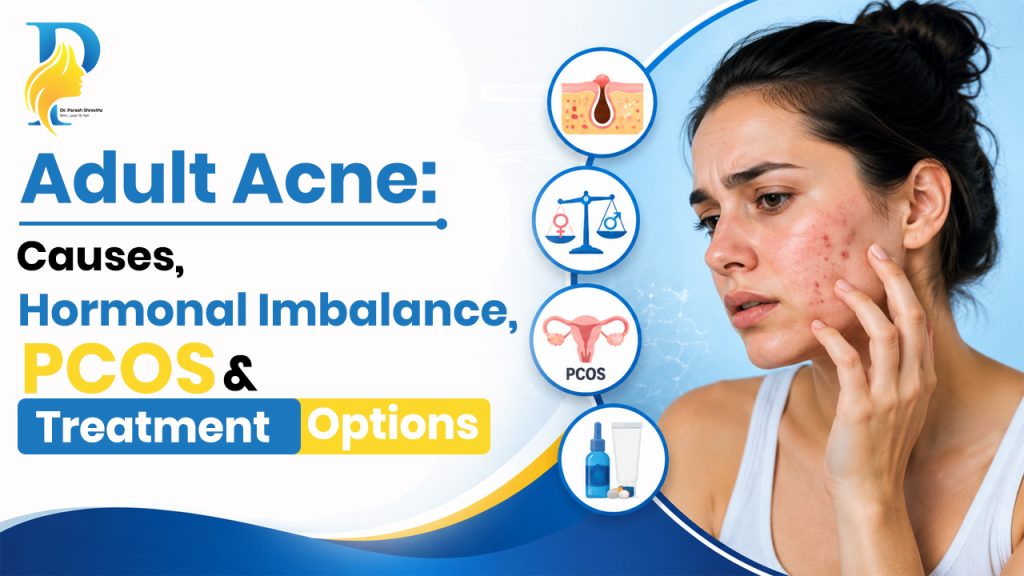
Adult acne is acne that persists beyond the teenage years or starts for the first time in adulthood. It can appear as blackheads, whiteheads, inflamed pimples, painful nodules, or recurring breakouts on the cheeks, chin, jawline, neck, chest, or back. While many people associate acne with adolescence, adult acne is common and treatable. The right adult acne treatment depends on the reason it is happening such as oil production, clogged pores, inflammation, hormones, skin care products, medications, or an underlying condition such as polycystic ovary syndrome (PCOS).
Quick answer: Adult breakouts are not always caused by “oily skin” or poor hygiene. A consistent, evidence-based treatment plan can usually reduce active acne and help prevent marks and scars. New, persistent, painful, or scarring acne deserves an assessment by a qualified dermatologist in Nepal, especially when it occurs with irregular periods, excess facial hair, scalp hair thinning, or sudden changes in the skin.
Adult acne at a glance
| Key fact | What it means for you |
|---|---|
| Acne can continue after the teens or begin after age 25. | You have not “missed” your chance for treatment. Adult-onset and persistent acne both need proper assessment. |
| Adult acne is often more common in women than men after adolescence. | Hormonal variation may be relevant, but acne alone does not prove a hormonal disorder. |
| Acne occurs through several processes at once. | Most people respond better to a combination plan than to repeatedly changing a single product. |
| Scars and dark marks can be prevented. | Control active acne early and avoid squeezing or picking lesions. |
| Improvement takes time. | Acne therapies usually need a consistent trial of several weeks; treatment is commonly reviewed at around 12 weeks. |
Acne overall is estimated to affect about 9.4% of the global population. Research on adult acne varies by country and by the age range studied, but it consistently shows that acne can continue well beyond adolescence and has a meaningful effect on confidence and quality of life.
What causes adult acne?
Adult acne develops when several skin processes overlap:
- More sebum (oil) is produced by the sebaceous glands.
- Dead skin cells collect inside pores, forming blackheads and whiteheads.
- Cutibacterium acnes, a normal skin bacterium, can contribute to inflammation within blocked follicles.
- Inflammation deepens, leading to red pimples, pustules, nodules, or cyst-like lesions.
Adult acne is not a cleanliness issue. Over-washing, scrubbing, and multiple drying products can irritate the skin barrier and worsen redness and marks.
Persistent acne vs late onset acne
There are two common patterns.
Persistent adult acne began in the teenage years and continues or returns later. Late onset adult acne starts after adolescence. Late onset deserves a review of hormones, cosmetics, medicines, and medical history, but location alone cannot diagnose the cause.
Why am I getting acne as an adult?
Several factors can contribute at the same time. The most common adult acne causes are listed below.
1. Hormonal fluctuations and androgen sensitivity
Androgens are hormones present in all genders. In the skin, they can stimulate oil glands and make pores more likely to block. Some people have normal blood hormone levels but skin that is more sensitive to androgen activity. Breakouts that flare before periods or recur predictably may suggest a hormonal influence, but jawline acne is not a diagnosis by itself.
Hormonal acne can also become more noticeable during pregnancy, after stopping or changing hormonal contraception, in the postpartum period, or around perimenopause. Treatment must be chosen carefully when pregnancy is possible because several acne medicines are unsuitable during pregnancy.
2. PCOS and other signs of androgen excess
PCOS is one possible contributor to adult acne, but it is not the explanation for every adult breakout. PCOS is a hormonal and metabolic condition that can affect ovulation and androgen activity.
Acne is more meaningful as a possible PCOS clue when it occurs alongside irregular or infrequent periods, unwanted coarse facial or body hair, female-pattern scalp hair thinning, difficulty with ovulation, or metabolic concerns. A sudden and severe increase in acne with rapidly progressing excess hair growth should be medically assessed promptly.
Importantly, acne by itself is a relatively weak predictor of biochemical androgen excess. A person should not be labelled as having PCOS solely because of jawline pimples or an ultrasound report. In adults, PCOS diagnosis requires a structured assessment of menstrual or ovulation pattern, androgen-related features, and ovarian features, while excluding other possible causes.
3. Skin-care, cosmetic, and hair products
Heavy, pore-clogging, fragranced, or irritating products can worsen acne in some people. This includes some foundations, sunscreens, facial oils, pomades, hair oils, leave-in conditioners, and makeup.
Choose products labelled “non-comedogenic” or “won’t clog pores” where possible. This is especially useful for moisturiser, sunscreen, makeup, and hair products that touch the forehead or cheeks. A new product is not automatically bad, but a flare that begins soon after its introduction is worth discussing.
4. Stress, sleep, and daily routine
Stress does not mean acne is “all in your head.” Stress can influence inflammation and may worsen breakouts in people already prone to acne. Poor sleep, inconsistent routines, and touching or picking the face may also make a flare harder to manage.
These factors support—not replace—medical treatment for moderate, painful, or recurrent acne.
5. Medicines and supplements
Some medicines can trigger acne-like eruptions or worsen existing acne. Examples may include certain corticosteroids, lithium, testosterone-containing products, and some hormonal preparations. Supplements marketed for muscle building, bodybuilding, or “hormone balance” can also be relevant.
Do not stop prescribed medicine by yourself. Share all medicines, vitamins, herbal products, and supplements with your dermatologist.
6. Family history and skin biology
A family tendency can increase the chance of acne. Skin type, oil-gland activity, inflammatory response, and the way your skin heals after a spot can all affect how acne behaves. This explains why a product can suit one person yet irritate another.
7. Diet: an area that needs a balanced approach
Some studies suggest that high-glycaemic dietary patterns may aggravate acne in certain people, but there is no universal “acne diet” and no single food that cures every case. Evidence around dairy is mixed and individual response can differ.
Instead of severe restriction, focus on regular meals, adequate protein and fibre, hydration, and a sustainable eating pattern. Avoid stopping essential foods or using extreme diets without discussing it with a qualified clinician, particularly when PCOS, pregnancy, diabetes, or an eating concern may be present.
Could my acne be related to PCOS?
The table below can help distinguish when a PCOS assessment may be worth discussing. It is not a self-diagnosis tool.
| Feature | Adult acne without clear PCOS features | Acne that may warrant PCOS or hormone assessment |
| Breakout pattern | Persistent or intermittent acne alone | Acne with a new or worsening hormonal pattern |
| Menstrual cycle | Usually regular | Irregular, very infrequent, or absent periods |
| Hair changes | No major change | New coarse facial/body hair or noticeable scalp thinning |
| Onset | Similar to previous acne pattern | Sudden severe acne or rapid change in symptoms |
| Next step | Dermatology assessment and routine-based treatment | Dermatology assessment plus gynaecology/endocrine evaluation when indicated |
A clinician may ask about your menstrual history, medicines, family history, weight and metabolic health, hair changes, pregnancy plans, and the timing of flares. Blood tests or ultrasound are selected only when symptoms and examination make them useful.
How is adult acne assessed?
A good consultation looks beyond the number of pimples. A skin specialist in Nepal will usually assess:
- the type of acne: comedonal, inflammatory, nodular, or mixed
- the areas involved: face, jawline, neck, chest, back, or hairline
- active inflammation, dark marks, and scar risk
- the timeline: persistent versus late-onset acne
- menstrual pattern, hair changes, pregnancy plans, and medicines when relevant
- current skin-care products, makeup, hair products, and prior treatments
- the emotional impact of acne, including confidence, work, social life, or distress
This prevents a common mistake: treating every flare with the same product. Sensitive skin with mild clogged pores needs a different plan from deep, painful lesions with early scarring.
Adult acne treatment options: what actually helps?
Treatment is based on severity, skin sensitivity, pregnancy potential, scar risk, and the likelihood of hormonal contribution. Dermatology guidelines support topical therapies such as benzoyl peroxide, topical retinoids, azelaic acid, and selected combination treatments. For moderate to severe acne, a dermatologist may consider oral medicines, hormonal therapy for suitable patients, or isotretinoin with strict monitoring.
1. A simple, acne-friendly daily routine
A basic routine supports any medical treatment.
Morning
- Cleanse gently; avoid harsh scrubs, cleansing brushes, or strong astringents.
- Apply treatment only if prescribed for morning use.
- Use a non-comedogenic moisturiser.
- Apply broad-spectrum sunscreen that suits acne-prone skin.
Evening
- Remove makeup gently.
- Cleanse with a mild product.
- Apply prescribed acne treatment as directed.
- Moisturise to protect the skin barrier.
Using more product does not clear acne faster. Too much active product can cause dryness, burning, peeling, and inflammation. Consistency is more valuable than a complicated 10-step routine.
2. Topical treatments for mild to moderate acne
Topical medicines are applied directly to the skin and are often the foundation of adult acne treatment.
| Treatment category | Main role | Common use | Important point |
| Benzoyl peroxide | Reduces acne-causing bacteria and inflammation | Inflamed pimples and combination treatment | Can cause dryness and may bleach fabrics |
| Topical retinoid | Helps prevent blocked pores | Blackheads, whiteheads, maintenance | May irritate initially; not used in pregnancy unless specifically advised |
| Azelaic acid | Helps acne and post-inflammatory dark marks | Sensitive or pigment-prone skin in selected cases | May be a useful option when tolerated |
| Topical antibiotic | Reduces inflammatory lesions | Usually used with another acne medicine | Should not be used alone for long periods because of antibiotic resistance |
| Combination topical treatment | Targets more than one acne process | Mild to moderate mixed acne | Often improves adherence and reduces the need to layer many products |
A dermatologist may start gradually, adjust frequency, or recommend a moisturiser strategy to reduce irritation. The goal is acne control without damaging the skin barrier.
3. Oral medicines for more inflamed or resistant acne
Oral antibiotics may be considered for moderate to severe inflammatory acne, usually for a limited period and alongside topical treatment. Antibiotics are not a long-term stand-alone solution because overuse can encourage resistance.
Hormonal treatment may be appropriate for some adult women with a clear hormonal pattern or PCOS-related symptoms. Depending on your medical history and pregnancy plans, this can include combined oral contraceptives or spironolactone. These are prescription decisions that require screening for suitability, discussion of risks, and reliable contraception where needed.
For severe, nodular, scarring, or treatment-resistant acne, isotretinoin may be recommended by a dermatologist. It can be highly effective, but it requires careful evaluation, monitoring, and strict pregnancy-prevention measures because it can cause serious birth defects if taken during pregnancy.
4. Treating acne marks and scars after active acne is controlled
Red, brown, or grey marks after pimples are not always permanent scars. They are often post-inflammatory colour changes and can fade gradually when new acne is controlled and sun protection is consistent.
Depressed acne scars are different. They may need procedures such as microneedling, subcision, chemical reconstruction techniques, or laser treatment, depending on scar type and skin tone. Active inflammation should generally be controlled first; otherwise, new breakouts can continue creating new marks.
For scar correction, see this guide to microneedling for acne scars in Nepal. Choose procedures after a scar-type assessment—not because they are trending or discounted.
How to control acne on the face without making it worse
Use these practical steps alongside your treatment plan:
- Cleanse twice daily and after heavy sweating, but do not scrub.
- Use non-comedogenic moisturiser and sunscreen; acne-prone skin still needs barrier support.
- Do not squeeze, pop, or repeatedly touch pimples. This increases inflammation and scar risk.
- Introduce one new active product at a time so you can recognise irritation.
- Keep hair oils, pomades, and styling products away from the forehead and cheeks when possible.
- Remove makeup before sleeping and clean makeup brushes regularly.
- Follow prescribed treatment for the recommended period, even when early improvement is slow.
- Arrange follow-up sooner if you develop significant irritation, deep painful lesions, scarring, or a sudden worsening.
Be cautious with home remedies such as toothpaste, lemon juice, undiluted essential oils, frequent scrubbing, and random steroid creams. These can burn or irritate the skin, worsen dark marks, and delay appropriate treatment.
When should you see a dermatologist for adult acne?
Arrange a dermatology consultation when:
- acne is painful, deep, widespread, or leaving scars
- adult-onset acne is persistent or suddenly worsening
- you have irregular periods, unwanted facial hair, or scalp hair thinning
- over-the-counter products have not helped after a consistent trial
- acne is affecting your confidence, sleep, work, or social wellbeing
- you are pregnant, planning pregnancy, breastfeeding, or taking medicines that may limit treatment choices
- you are considering isotretinoin, chemical peels, laser, or scar procedures
A dermatologist can stage care: control active disease, prevent relapse, then address marks or scarring. This is safer than switching products every few weeks.
Frequently asked questions about adult acne
How do I get rid of my adult acne?
Start with a gentle, non-comedogenic routine and use acne treatments consistently for several weeks. The best adult acne treatment depends on whether you have clogged pores, inflammation, deep lesions, scar risk, or a hormonal pattern. See a dermatologist if acne is painful, persistent, scarring, or associated with irregular periods or excess hair growth.
Why am I getting acne as an adult?
Adult acne can result from increased oil production, blocked pores, inflammation, hormone fluctuations, PCOS, family tendency, skin-care or hair products, medicines, and stress-related flares. It is often caused by several factors together, not one single mistake.
How to control acne on face?
Cleanse gently twice daily, use non-comedogenic moisturiser and sunscreen, avoid picking, and use a proven acne treatment as advised. Avoid harsh scrubs, toothpaste, and random steroid creams. Give a treatment plan time to work and seek care early if acne is deep, painful, or scarring.
Will adult acne go away?
Adult acne can improve substantially with the correct treatment and maintenance plan, but it may relapse if the underlying tendency remains. Some people need long-term topical maintenance or hormone-focused treatment. Early treatment can reduce the risk of persistent marks and scars.
The bottom line
Adult acne is manageable. Identify the acne pattern, assess relevant PCOS or hormonal features, protect the skin barrier, and use evidence-based treatment consistently.
Dr. Parash Shrestha is a consultant dermatologist with 15+ years of experience in clinical and cosmetic dermatology, including acne, pigmentation, laser care, and scar management. For a personalised plan, consult Dr. Parash Shrestha for an assessment based on your skin type, symptoms, medical history, and treatment goals.
Medical disclaimer: This article is for general education and does not replace an in person medical assessment. Prescription medicines and procedures should be selected only after consultation with a qualified clinician.
Author bio: Dr. Parash Shrestha, MBBS, MD, FAM, NMC No. 7527, is a consultant dermatologist in Nepal. His practice focuses on clinical dermatology, cosmetic dermatology, laser treatments, and long-term skin and hair care.