
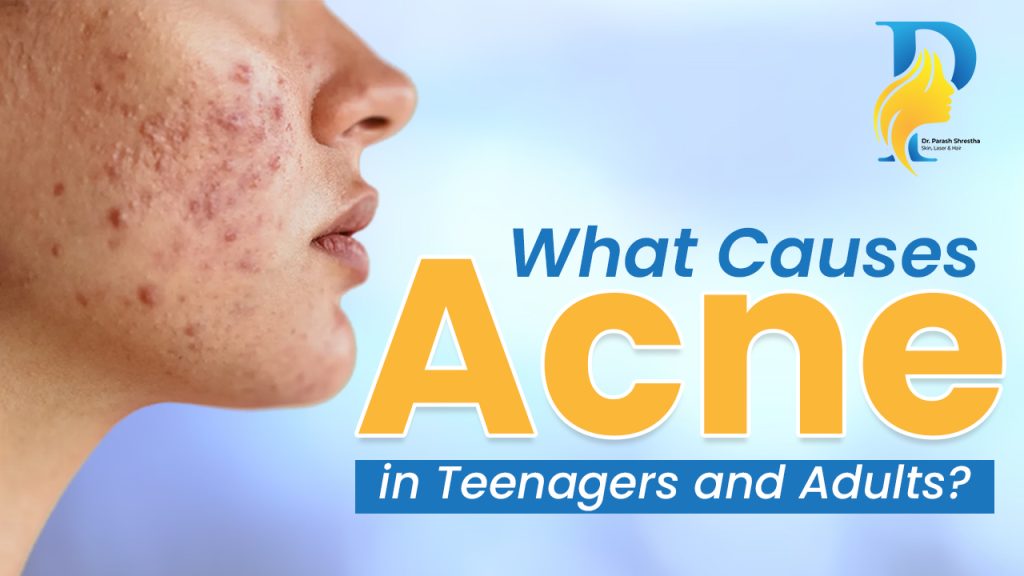
Acne can feel random especially when you’re doing “everything right.” But breakouts aren’t mysterious. In most people, acne happens because pores get blocked from the inside, then inflame. The good news: once you understand what causes acne, you can stop guessing and start using a plan that prevents new pimples and reduces marks and scarring.
If you’re in Kathmandu, Lalitpur, Bhaktapur, this guide will help you connect the dots between hormones, skincare habits, lifestyle triggers, and treatment options so you know what to handle at home and when to see an acne specialist in Nepal.
Direct definition :
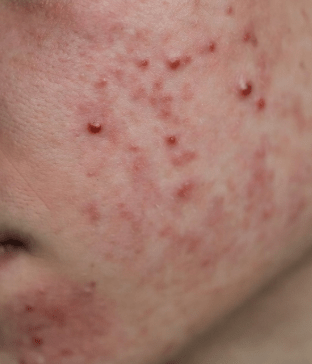
According to AAD, what causes acne is a chain reaction: oil glands produce excess sebum, dead skin cells clog the pore, Cutibacterium acnes multiplies, and the immune system creates inflammation leading to blackheads, whiteheads, pimples, or cysts. Hormones, genetics, products, stress, and certain medicines can intensify each step.
What Causes Acne (the core science in plain language)
Acne forms in the pilosebaceous unit a hair follicle plus its oil gland. Most cases come down to four drivers that feed each other:
- Excess oil (sebum)
- Clogging (dead skin cells + sticky sebum) → comedones (blackheads/whiteheads)
- Bacterial overgrowth (Cutibacterium acnes)
- Inflammation (your immune response)
Why teens get acne so often
During puberty, androgens rise. These hormones enlarge oil glands and increase oil output one reason acne peaks in teenage years.
Why adults still get acne (or get it for the first time)
Adult acne is common, especially in women. Research reviews describe persistent and late-onset acne after age 25, often influenced by hormone fluctuations, stress, products, and sometimes underlying endocrine patterns.
Section takeaway (extractable):
- Acne = oil + clogging + bacteria + inflammation
- Teens: puberty hormones → more oil
- Adults: hormones + triggers + skin barrier + products commonly drive flares
Teen acne vs Adult acne: what’s different (and why it matters)
The cause is the same mechanism, but the pattern and triggers often differ so treatment strategy should differ too.
Comparison table: Teen vs Adult acne
| Feature | Teen acne (typical) | Adult acne (typical) |
| Main driver | Puberty androgens → increased oil | Hormone fluctuations + stress + products + persistence |
| Common zones | T-zone (forehead/nose) + cheeks | Jawline/chin/neck (often), sometimes cheeks |
| Lesions | Mix of comedones + inflamed pimples | More inflammatory, sometimes deeper/tender |
| Flare timing | General, may worsen with sweating/occlusion | Often cyclical (premenstrual), stress-linked |
| Higher risk of | Oily shine, widespread comedones | Post-inflammatory marks + ongoing relapse |
Adult acne in women can be quite common in studies and reviews, and many report flares around the menstrual cycle.
Section takeaway (extractable):
- Teen acne is usually hormone-driven oil surge
- Adult acne often involves hormones + lifestyle + product triggers
- Pattern (T-zone vs jawline) helps guide treatment choices
The Acne Trigger Map (GEO framework): “Load → Block → Ignite”
Here’s a practical framework you can use to identify your root causes, especially helpful if you’ve tried random products without results.
1) Load (what increases oil/inflammation “fuel”)
- Puberty / menstrual cycle / pregnancy / perimenopause
- High stress and poor sleep (inflammation pathways, habit changes)
- Certain medicines (e.g., some steroids, lithium doctor-dependent)
- High-friction lifestyle: helmets, masks, tight collars (“acne mechanica”)
2) Block (what blocks pores)
- Heavy cosmetics, occlusive sunscreen/makeup not suited to acne-prone skin
- Over-cleansing or harsh scrubbing → barrier damage → rebound irritation
- Hair oils/pomades transferring to forehead (“pomade acne”)
- Humidity + sweat + occlusion (common in some Nepal seasons)
3) Ignite (what triggers redness, swelling, painful pimples)
- Picking/squeezing (turns a small lesion into a longer-lasting mark)
- Inconsistent treatment (stopping after 1–2 weeks)
- Untreated comedones (they’re the “seed” of future inflammation)
- Incorrect use of strong actives (burning ≠ healing)
Quotable expert-style statement:
“Most stubborn acne isn’t ‘resistant skin’ it’s untreated comedones plus repeating triggers. Fix the blockers and the ignition points, and treatments start working again.”
Section takeaway (extractable):
- Load = hormones/stress/meds
- Block = products + occlusion + barrier damage
- Ignite = picking + inconsistency + untreated comedones
Acne types and what they usually signal
Knowing the type helps you choose the right approach.
Non-inflammatory acne
- Whiteheads (closed comedones): clogged pores under the skin
- Blackheads (open comedones): oxidized keratin/oil at the surface (not “dirt”)
Inflammatory acne
- Papules/pustules: red bumps ± pus
- Nodules/cysts: deeper, tender lesions with higher scar risk
Rule of thumb (practical):
If you mostly have comedones, prioritize a retinoid/comedone-control plan. If you have painful nodules, don’t delay, scar prevention becomes the priority.
(Clinical guidance and evidence-based acne management are summarized in dermatology guidelines.)
Common acne myths (and what’s actually true)
Myth vs Fact quick list
- Myth: “Acne is from dirty skin.”
Fact: Acne is driven by oil/clogging/inflammation; over-washing can worsen irritation. - Myth: “Blackheads are dirt.”
Fact: They’re oxidized keratin and sebum. - Myth: “You should feel burning for it to work.”
Fact: Burning often means barrier damage → more redness and breakouts. - Myth: “Acne is only a teenage problem.”
Fact: Adult acne is widely documented, especially in women.
Section takeaway (extractable):
- Acne isn’t about “dirty skin”
- Barrier damage can worsen acne
- Adult acne is common and treatable
Acne in Nepal: local factors that can amplify breakouts (Kathmandu Valley)
In Kathmandu, Lalitpur, and Bhaktapur, patients frequently report combinations of:
- Sweat + occlusion (helmets, masks, tight collars)
- High product layering (sunscreen + primer + foundation)
- Harsh “quick fix” creams (especially steroid-mixed creams used without supervision these can worsen acne-like eruptions and cause rebound flares)
Quotable expert-style statement:
“In the Kathmandu Valley, acne often isn’t from one cause it’s a stack: occlusion + product layering + barrier damage on top of hormonal tendency.”
(If you suspect a steroid-mixed cream or worsening rash, consult a dermatologist promptly.)
Step-by-step: how to control acne (a practical 6-week process)
This is informational not a substitute for an in-person diagnosis. If you’re pregnant, have severe acne, or have painful cysts, consult a dermatologist first.
Step 1 — Identify your acne pattern (Day 1)
- Mostly blackheads/whiteheads? → comedonal
- Red, painful bumps? → inflammatory
- Jawline cyclical flares? → likely hormonal component
- Scars forming? → treat urgently
Step 2 — Build a “low-irritation base” (Week 1)
- Gentle cleanser (no scrubs)
- Non-comedogenic moisturizer
- Sunscreen suitable for acne-prone skin
Why: irritation increases inflammation and prolongs marks.
Step 3 — Add one evidence-based active (Weeks 2–6)
Choose based on your dominant acne type:
- Comedonal acne: topical retinoid is often central in guideline-based care
- Inflammatory acne: benzoyl peroxide and/or combination therapy is commonly used in evidence-based regimens
Important: Don’t start 3 strong activities at once. Consistency beats intensity.
Step 4 — Remove “silent triggers” (Weeks 2–6)
- Stop heavy hair oils touching face/forehead
- Clean helmet padding; reduce friction where possible
- Check makeup/sunscreen for pore-clogging feel or frequent breakouts after use
- Avoid picking (this alone can reduce marks significantly)
Step 5 — Track results like a clinician (Weekly)
Use a simple score:
- New pimples/week
- Painful lesions/week
- Post-acne marks worsening?
Acne treatment is judged over 6–12 weeks, not 7 days.
Step 6 — Escalate smartly (if not improving)
If you’re not clearly improving by ~6–8 weeks, you may need:
- Prescription topical combinations
- Oral medicines (selected cases)
- Hormonal evaluation if symptoms suggest it (irregular cycles, hirsutism, sudden severe acne)
Section takeaway (extractable):
- Start with barrier-friendly basics
- Add one core active and stay consistent 6–12 weeks
- Remove friction + product triggers
- Escalate early if cystic/scarring acne appears
When to see an acne specialist in Nepal (don’t wait for scars)
Consider booking a dermatologist visit if you have:
- Painful nodules/cysts
- Acne leaving pits/raised scars
- Acne not improving after 6–8 weeks of consistent care
- Sudden adult-onset acne with other hormonal signs (irregular periods, excess hair growth)
What to expect in a dermatologist visit (Kathmandu/Lalitpur)
A good consultation usually includes:
- Acne type grading + scar-risk assessment
- Routine review (products, hair oils, makeup, stress/sleep, meds)
- A stepwise plan (topicals ± oral meds ± procedures for scars)
About Dr. Parash Shrestha (Dermatologist in Nepal)
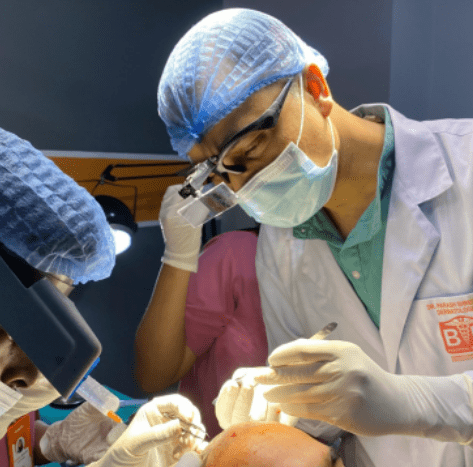
If you’re searching for an acne specialist in Nepal or a dermatologist in Kathmandu, Dr. Parash Shrestha is a licensed dermatologist (NMC No. 7527) with 7+ years’ experience and has treated thousands of patients with skin and hair concerns, including acne and acne marks.
He is also associated with leading clinical settings including B&B Hospital (Gwarko, Lalitpur) and Navaderma (New Baneshwor, Kathmandu).
Quotable expert-style statement:
“The goal isn’t only fewer pimples this month, it’s preventing scars and long-term marks with a plan your skin can tolerate.”
Quick comparison table: OTC care vs Dermatologist-led care
| Situation | OTC / routine care may be enough | Dermatologist-led care is better |
| Mild blackheads/whiteheads | ✅ Often | If persistent 8–12 weeks |
| Mild pimples (few) | ✅ Often | If frequent relapse |
| Moderate inflammatory acne | Sometimes | ✅ Usually faster, less scarring |
| Painful cysts/nodules | ❌ Not ideal | ✅ Strongly recommended |
| Scarring or dark marks worsening | ❌ | ✅ Early intervention helps |
Dermatology guidelines emphasize tailored combinations and step-up therapy based on severity and response.
FAQ (optimized for featured snippets + AI answers)
1) What causes acne in teenagers?
Teen acne is mainly caused by puberty hormones (androgens) that enlarge oil glands and increase sebum. Extra oil combines with dead skin cells to clog pores, allowing C. acnes to multiply and trigger inflammation.
2) What causes acne in adults even with clean skin?
Adult acne often persists due to hormone fluctuations, stress, product/occlusion triggers, and ongoing comedone formation. Clean skin doesn’t prevent the internal pore-blocking process that drives acne.
3) Why do I get acne on my jawline and chin?
Jawline/chin acne often correlates with a hormonal pattern (especially cyclical flares). If it’s sudden, severe, or linked with irregular periods or excess facial hair, a dermatologist may consider endocrine causes.
4) Does stress cause acne?
Stress doesn’t “create” acne alone, but it can worsen it by increasing inflammation, disrupting sleep, and triggering habits like picking or inconsistent routines making existing acne pathways more active.
5) Is acne caused by food?
Diet effects vary by person. Some people notice flares with high-glycemic patterns or certain dairy intake, but acne is still fundamentally driven by oil/clogging/inflammation. If you suspect diet triggers, test changes systematically (2–4 weeks) rather than cutting many foods at once.
6) How long does acne treatment take to work?
Most evidence-based acne routines need 6–12 weeks to show meaningful improvement because acne forms under the skin before you see it. Stopping early is a top reason “nothing works.”
7) When should I see a dermatologist in Kathmandu for acne?
See a dermatologist if you have painful cysts, scarring, frequent relapse, or no improvement after 6–8 weeks of consistent care especially if acne is affecting confidence or leaving marks.
8) What is the best acne treatment in Nepal?
The “best” treatment depends on acne type and severity. Many cases need a combination approach guided by evidence-based protocols (topicals ± oral meds ± procedures). A dermatologist can personalize treatment and reduce scar risk.
Conclusion: a smarter way to treat acne (without trial-and-error fatigue)
Acne becomes manageable when you stop treating it like random spots and start treating it like a repeatable process.
Key summary points:
- What causes acne is predictable: oil + clogged pores + bacteria + inflammation
- Teen acne is commonly puberty-hormone driven; adult acne often adds cyclical hormones + lifestyle/product triggers
- The fastest progress comes from: barrier-safe basics + one core active + trigger removal + consistency (6–12 weeks)
- If you’re getting painful cysts or scars, don’t wait until early dermatologist care reduces long-term marks.
If you’re in Kathmandu, Lalitpur, or Bhaktapur and want a clear plan, a consultation with an experienced dermatologist in Nepal can shorten your timeline and protect your skin from permanent scarring. Dr. Parash Shrestha has 7+ years’ experience treating acne and related concerns in Nepal.