
When you look in the mirror, you only see the “final result” of your skin’s health: the visible spots, the fine lines, and the uneven tone. However, the human eye is remarkably limited. It cannot see the damage brewing in the deeper layers of the dermis, nor can it accurately measure the depth of pigmentation that hasn’t surfaced yet.
For years, patients would visit a Dermatologist in Kathmandu or a Dermatologist in Lalitpur describing “sudden” dark spots. In reality, these spots weren’t sudden; they were years in the making. Today, advanced skin analysis machines have revolutionized how a doctor diagnoses and treats these issues, moving from subjective observation to objective, data-driven science.

The Anatomy of Pigmentation: Why Depth Matters
To understand how a scanner works, we must first understand the structure of the skin. Your skin is not a single sheet; it is a complex, multi-layered organ.
1. The Epidermal Layer (The Surface)
This is the outermost layer. Pigmentation here is often “new” or the result of recent sun exposure. Spots in this layer are usually easier to treat with topical creams or light chemical peels because the cells turn over every 28–40 days.
2. The Dermal Layer (The Deep Tissue)
The dermis sits beneath the epidermis. When pigmentation reaches this depth often due to chronic sun damage, hormonal changes (Melasma), or deep inflammation it becomes “entrenched.” Surface-level treatments cannot reach this depth effectively.
3. The Dermal-Epidermal Junction (DEJ)
This is the “basement membrane” where the two layers meet. Damage here often requires sophisticated laser intervention.
How Do Skin Scanners See the “Invisible”?
Advanced diagnostic tools, like those used by a Dermatologist in Nepal, utilize three primary types of imaging technology to map your skin’s health.
RGB (Visible Light) Imaging
This captures what the human eye sees but at a much higher resolution. It documents the current state of your skin, including visible pores, redness, and surface-level spots. It serves as the “baseline” for your medical record.
Cross-Polarized Lighting
This technology eliminates the “glare” and reflections from the skin’s surface. By doing so, it allows the doctor to see the vascular (blood vessel) structure and underlying inflammation. This is crucial for diagnosing conditions like Rosacea or hidden irritation that might be causing “phantom” sensitivity.
UV (Ultraviolet) Fluorescence
This is the “time machine” of dermatology. UV light causes certain substances in the skin, such as porphyrins (bacteria) and melanin (pigment), to glow or darken. It reveals sun damage that is currently hidden beneath the surface but is guaranteed to emerge as a dark spot in 1–3 years if left untreated.
| Technology | What it Detects | Clinical Utility |
| RGB Imaging | Visible spots, wrinkles, pores | Progress tracking & baseline |
| Polarized Light | Redness, inflammation, thin skin | Sensitivity & vascular diagnosis |
| UV Imaging | Subsurface melanin, sun damage | Prevention & deep-pigment mapping |
Why All Spots are Not Created Equal
A common frustration for patients is why a “whitening cream” works for a friend but not for them. The answer lies in the pigmentation depth. Without a scan, even an experienced Dermatologist in Kathmandu might find it challenging to distinguish between epidermal and dermal melasma through visual inspection alone.
The Role of the Skin Analysis Machine
A professional scanner provides a “Skin Score.” This score compares your skin against a global database of thousands of individuals of the same age and skin type.
- Percentile Scores: If your “UV Spots” score is in the 10th percentile, it means 90% of people your age have better-protected skin than you do.
- Mathematical Precision: It quantifies the exact area of damage, allowing the doctor to monitor if a treatment is actually working by looking for a percentage decrease in pigment density.
Top 5 Benefits of Professional Skin Analysis in 2026
1. Early Detection of Sun Damage
Skin scanners can detect “latent” pigment. If you see a cluster of dark spots on a UV scan that aren’t visible in the mirror yet, you can start using specific antioxidants and higher-grade SPF to prevent them from ever surfacing.
2. Accurate Treatment Selection
Should you get a Carbon Peel, a chemical peel, or a Q-Switched Laser? The scanner decides. Epidermal spots respond well to peels, but dermal pigmentation usually requires the specific wavelength of a laser to shatter the deep-seated melanin.
3. Monitoring Treatment Efficacy
Often, deep treatments take months to show surface results. A scanner allows your Dermatologist in Lalitpur to show you that the pigment is breaking up underneath, even if you don’t see it yet. This keeps patients motivated and compliant.
4. Personalized Product Matching
In 2026, “one size fits all” skincare is dead. By analyzing pore size and sebum (oil) levels, the machine helps the Doctor recommend products that won’t clog your pores or dry out your barrier.
5. Identifying Biological vs. Chronological Age
Many modern machines now offer a “TruAge” feature. This tells you if your skin is behaving like a 30-year-old’s or a 50-year-old’s based on elasticity and damage levels.
The 2026 Landscape: Dermatology in Nepal

Nepal has seen a significant shift in medical aesthetics. Finding a qualified Dermatologist in Nepal is now easier, but choosing the right clinic depends on the technology they utilize. At the clinic of Dr. Parash Shrestha, the focus is on “Integrative Diagnostics” combining clinical expertise with high-tech imaging.
Whether you are looking for a Dermatologist in Kathmandu for acne or a Dermatologist in Lalitpur for aging concerns, always ask: “Do you perform a subsurface skin analysis before starting treatment?”
Case Study: The “Invisible” Melasma
Consider a patient who complained of a small patch of darkness on their cheek. To the naked eye, it looked like a simple sunspot.
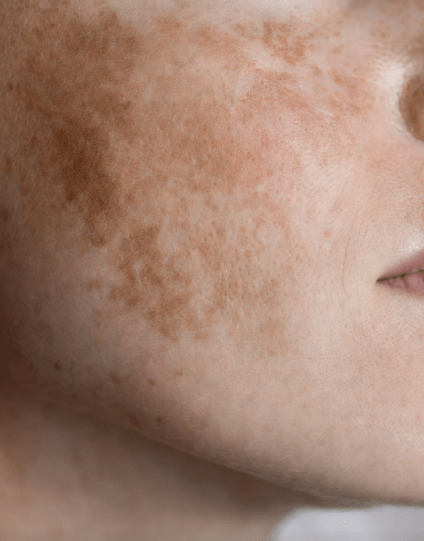
Upon scanning with a multispectral device, the doctor discovered that the pigment was actually part of a much larger, symmetrical “mask” of Melasma that was deeply rooted in the dermis. Instead of a standard exfoliating facial, the patient was started on a specialized medical protocol. Without the scan, the patient would have wasted time and money on treatments that couldn’t reach the required depth.
Understanding the Results: What Your Report Means
When you receive your skin analysis report, you will likely see several categories:
- Spots: Typically brown or red skin lesions including freckles, acne scars, and hyperpigmentation.
- Wrinkles: Breaks in the skin caused by a loss of collagen and elasticity.
- Texture: An analysis of the “peaks and valleys” of your skin surface.
- Pores: Circular openings across the skin surface.
- UV Spots: Pigment and sun damage just below the skin surface.
- Brown Spots: Deeper pigmentation and lentigines.
- Red Areas: Representing capillary vessels (vascularity) and inflammation.
- Porphyrins: Bacterial excretions that can lead to acne.
Frequently Asked Questions (FAQ)
Is a skin scan painful?
No. It is a completely non-invasive procedure. You simply place your face in a specialized booth or cradle, and several high-resolution photos are taken with different light flashes. It takes about 10–15 minutes.
How often should I get my skin scanned?
For most patients, once every 6 months is ideal. If you are undergoing active treatment for pigmentation, your dermatologist may recommend a scan every 4–8 weeks to track progress.
Does insurance cover skin analysis in Nepal?
Generally, skin analysis for cosmetic purposes is not covered. However, if it is used for the diagnosis of a medical condition like skin cancer or severe dermatitis, check with your specific provider and your dermatologist in Nepal.
Can I wear makeup during the scan?
For the most accurate results, you should arrive with a clean, makeup-free face. Makeup, especially those with SPF or metallic pigments, can interfere with UV and polarized light sensors.
Is the technology safe?
Yes. The “UV” light used in scanners is a very low-energy flash, similar to a standard camera flash, and is not harmful to the skin or eyes.
Conclusion: Knowledge is Power for Your Skin
Your skin is a living record of your history, your sun exposure, your stress levels, and your genetics. While the surface only tells part of the story, modern technology allows us to read the entire “book” of your skin health.
If you are struggling with stubborn pigmentation or simply want to prevent premature aging, visiting a Dermatologist in Kathmandu or a Dermatologist in Lalitpur for a professional scan is the smartest investment you can make.
By going “Beyond the Surface,” you allow your dermatologist to create a roadmap that is as unique as your DNA. Don’t guess; let science lead the way to your most radiant skin.